
How Next Generation Predicted the "Manosphere"
Or: How Data's anger addiction helped me understand social media

Star Trek is credited with anticipating many things, most technological. For instance Captain Kirk’s communicators inspired the late lamented “flip phone,” while the Next Generation crew’s piles of Padds planted the seed for the iPad. In the area of politics, they have been less successful. I have thoroughly investigated the matter, and there was no global war among genetically augmented supermen in the 90s—as predicted in “Space Seed” and then doubled down upon in Wrath of Khan—and our hopes that, as Data once claims, Irish Unification would occur in 2024 were ultimately dashed.
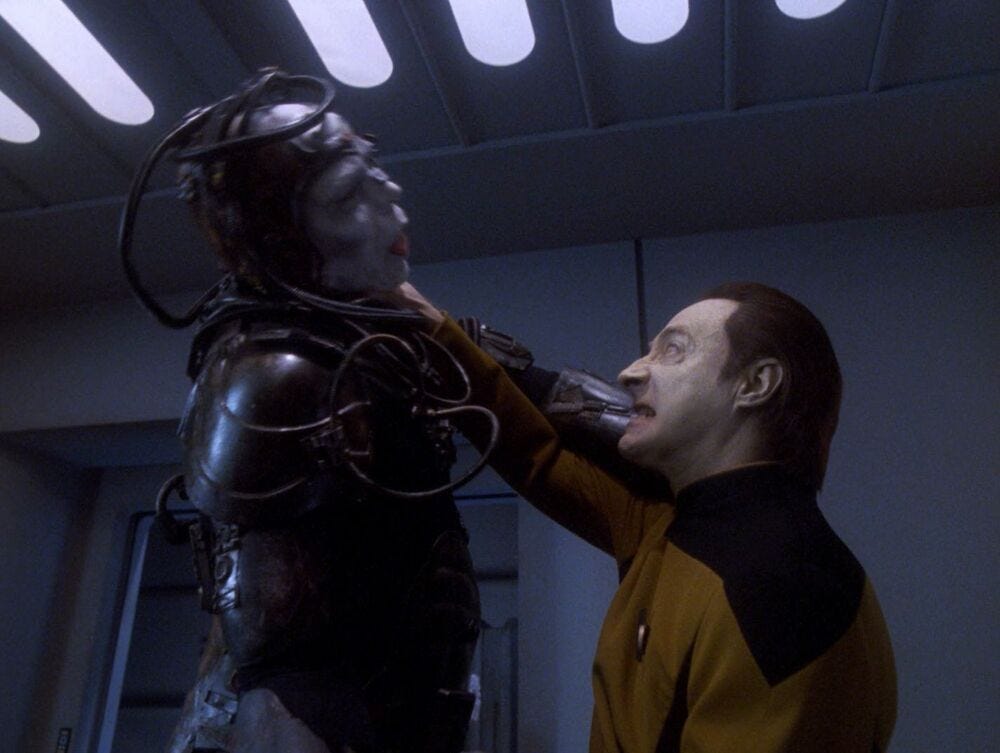
There is one episode, though, that stands out to me as deeply prescient for our present moment: “Descent,” the two-parter that bridges seasons 6 and 7. This may seem surprising, because if you just list out the things included in the episode—Data’s emotion chip, his evil twin Lore, a rogue faction of Borg—it could sound a bit like mashed-up fan service. But there’s a deep truth at work in the episode that arguably only became fully legible in our contemporary world.
The key to the episode for me is an aspect that didn’t make sense to me when we were first watching Next Generation in the early 2010s—namely, the fact that Lore is able to manipulate Data by allowing him to feel anger, but no other emotion. Back in those more innocent times, I recognized that Data has longed to experience emotion for his entire life, but the idea that anger alone would be enough to get him to betray his friends felt strange and wrong to me. Returning to it after social media reached its full fetid blossoming, I now realize how short-sighted I was. People are out there blowing up their own lives chasing the next hit of anger every single day. In fact, several of them are currently running our government!
According to Jeri Taylor (quoted in Memory Alpha), part of the writers’ goal was to explore topics related to cults and charismatic leaders. This is where the Borg aspect of the plot comes in. In one of my favorite episodes of all time, the Enterprise crew rescued a Borg drone who, once disconnected from the Borg Collective, came to embrace his own individuality and took on the name Hugh. Picard ultimately backed down from his plan to use Hugh to inject a virus into the Collective that would permanently disable them, but as it turns out, Hugh’s individuality itself was already enough to cause major disruption—leaving Hugh’s Cube (or the whole Collective?) paralyzed and helpless. In Hugh’s own words:
You don't know the condition we were in when he found us. Before my experience on the Enterprise, the Borg were a single-minded Collective. The voices in our heads were smooth and flowing. But after I returned, those voices began to change. They became uneven, discordant. For the first time, individual Borg had differing ideas about how to proceed. We couldn't function. Some Borg fought each other. Others simply shut themselves down. Many starved to death.
When his former friends from the Enterprise express skepticism that Lore could ever take control of the mighty Borg, Hugh follows up with a line that sounds almost too perfect: “You probably can't imagine what it is like to be so lost and frightened that you will listen to any voice which promises change.” (Quotes taken from this excellent fan resource.)
In the episode as it stands, Lore’s manipulation of the disabled Borg and of Data are not explicitly integrated. And that makes sense—Lore is dealing with two very different phenomena in the two cases and different techniques would be called for. But there is one telling scene where one of Lore’s lieutenants rats out a drone who is not remaining connected to Lore’s mini-Collective. Lore manipulates him into reconnecting by claiming he will gain strength through community, though the audience obviously realizes that Lore is offering only the shallow pleasures of obedience and conformity. Here we might think of the “manosphere” social media influencer—or, less anachronistically, a right-wing shock-jock. There’s an article on Rush Limbaugh (which I will never be able to find) that highlights the way that he trains his callers to interpret other emotions, such as confusion or frustration or even just concern, as anger. And it’s been well-documented that anger travels much more easily in social networks than any other emotion.
Hence perhaps our contemporary experience provides a way to bring together what the writers only juxtaposed. Perhaps what Lore is offering both Data and his Borg drones is a hit of anger. Both wind up offering Lore unquestioning obedience, but Data’s submission to Lore is only won through an initial disinhibition, a giving of permission, as represented in the suppression of Data’s “ethical subroutines.” Again, we might think of the thrill that young men experience when they enter spaces where they can finally express themselves openly—but only negatively, through indulging in slurs and resentment toward other groups. Finally, they aren’t smothered by political correctness! But again, this supposed self-expression is only a new and more malign form of obedience and conformity.
Even the strangest plot point, where Lore seeks to replace the Borg’s organic parts with fully artificial equivalents, seems to fit uncannily into our present-day situation. (And not just because Elon Musk’s braindead social media followers appear willing to receive brain implants from a guy whose products are famous for conspicuously failing.) We are regularly exhorted to outsource our choices to “the algorithm” and now, more radically, to AI, and given past performance of various algorithms, that has led to concerns about ever-greater political polarization and radicalization. And surely a lot of that happens because the biases of the wider society get baked into and reinforced by the algorithm. But there’s an additional factor with algorithmic sorting, because the algorithm is incentivized to nudge you into spaces where your behavior becomes more predictable and it can therefore be more assured of serving you something you like. (I draw this idea from Kieran Healy and Marion Fourcade’s excellent book The Ordinal Society.) In other words, part of the reason people keep getting radicalized by social media platforms is that the impersonal algorithms of the platform find them easier to manage and predict once they’ve been radicalized. Once again, the promise of freedom from a stifling conformity is an even more profound conformity.
At this point, you may be asking what this episode offers us beyond an uncanny anticipation of our post-social media political landscape. Does it offer us any ways to resist? Unfortunately, the decisive moment comes when Picard manages to steal one of the Borg drone’s implants and use it to create a cation pulse that disrupts Lore’s control over Data—a tactic that may not prove as effective in our context. Other than that, the answers are as obvious as they are difficult: unplug, resist, and—as Hugh does after Lore has been dethroned—take responsibility for yourself and others.