
Spock Must Die!
Spockly Superfluity and Ensoulment

[Spoilers throughout for Blish’s novel]
.
Over on Bluesky recently there was a discussion, familiar to Trekkies, regarding the concept that the transporter operates by making a perfect copy of a person in the desired location and then annihilating the original person.1 In such a circumstance, would you sir, or you madam, step into the device? Blueskier Stephen Bush says: no.
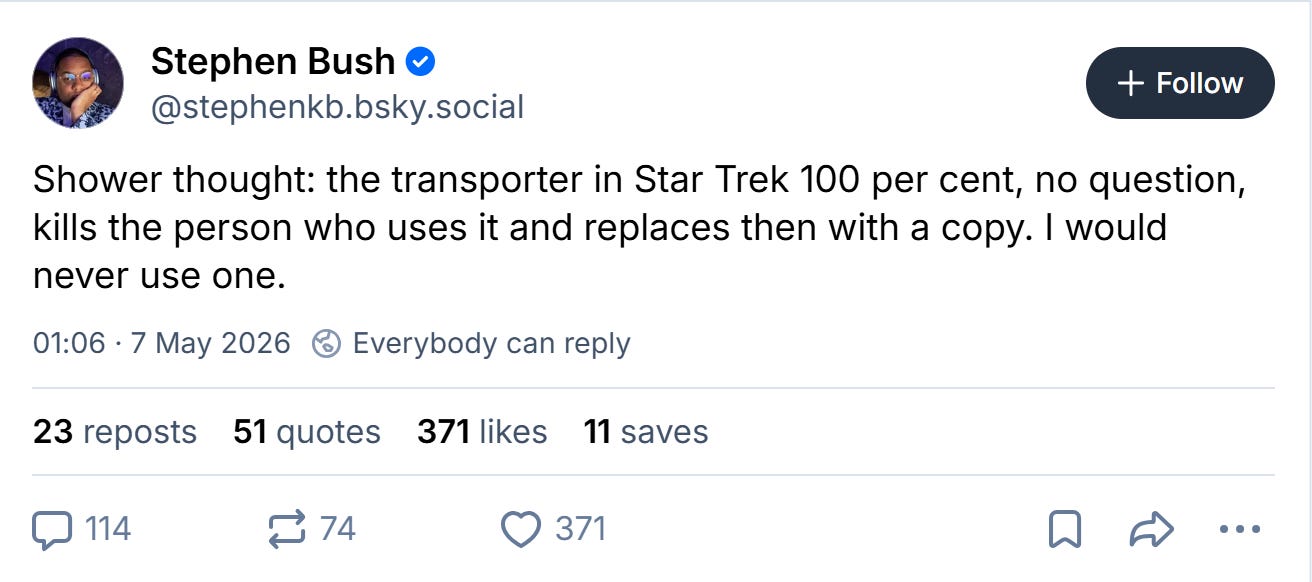
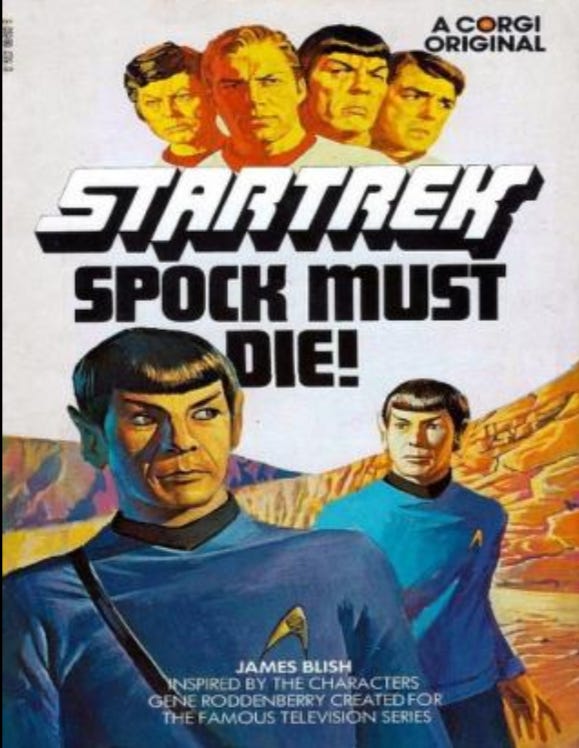
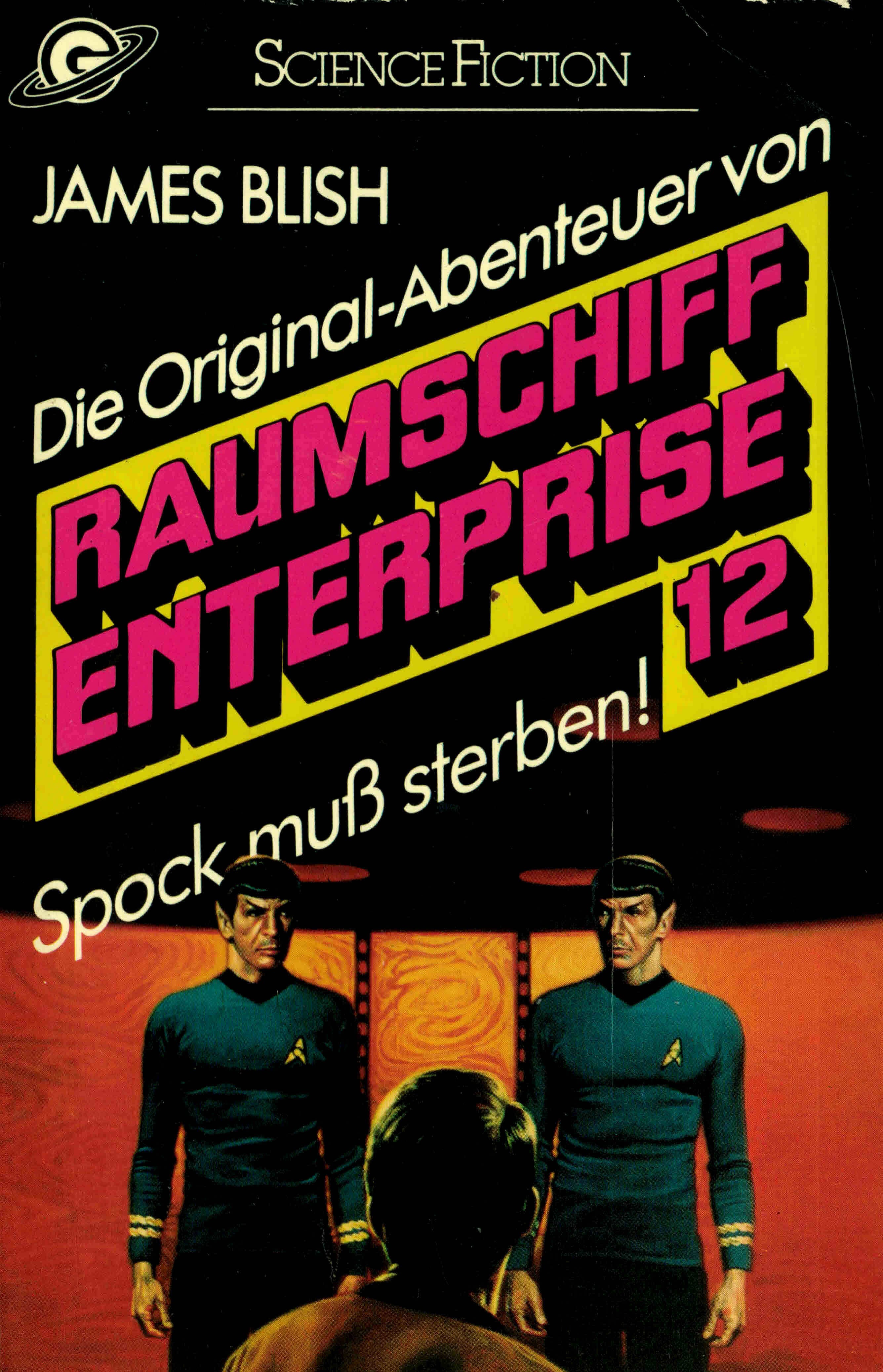
I quote-replied: ‘imagine you discovered that every time you go to sleep at night you die and an exact replica of you occupies your body when you wake. You'd still go to sleep tonight. It's happened thousands of times before: why worry now?’ There was some discussion of the premise, and my friend Barry Langford reminded me that this very question opens James Blish’s tie-in novelisation Spock Must Die! (1970). Since that novel also obliquely addresses the underlying premise of the ‘Mirror Universe’ trope, upon which Other-Adam recently ’stacked, I thought I would revisit the book, which I read in the decade in which it appeared, but which I hadn’t looked at since.
Blish, a notable science fiction author in his own right, and important for the history of the genre, spent his latter years as a writer (to quote Peter Nichols and David Langford) ‘much preoccupied with Star Trek books, beginning with Star Trek (collection 1967) and ending with Star Trek 11 (1975). These are based on the original Television scripts, and hence are in fact collaborations, but Spock Must Die! (1970) is an original work, the first original adult Star Trek novel (it was preceded by Mack Reynolds's Mission to Horatius [1968], a juvenile).’ I approve Blish’s title choice, as a big fan of book-titles that include exclamation marks (the first, I believe, is Charles Kingsley’s 1855 Westward Ho!, a book so popular in its day that a Devonian village is named after it).2
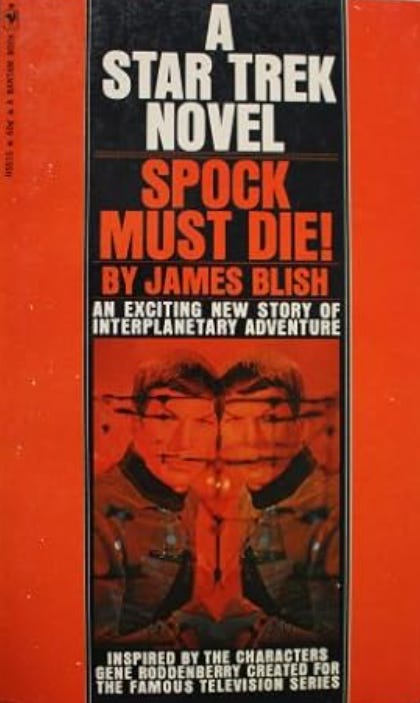
Spock Must Die! opens with McCoy expressing his anxiety (after having, by his own admission, happily used the technology for two decades) that the transporter operates by killing its users:
“What worries me,” McCoy said, “is whether I’m myself any more. I have a horrible suspicion that I’m a ghost. And that I’ve been one for maybe as long as twenty years.”
The question caught Captain Kirk’s ear as he was crossing the rec room of the Enterprise with a handful of coffee. It was not addressed to him, however; turning, he saw that the starship’s surgeon was sitting at a table with Scott, who was listening with apparently deep attention. Scotty listening to personal confidences? Or Bones offering them? Ordinarily Scotty had about as much interest in people as his engines might have taken; and McCoy was reticent to the point of cynicism. [Spock Must Die, 6]
That Kirk drinks coffee straight from his cupped hands is a surprising detail and not, I believe, canon. Scotty attempts to reassure the good doctor: ‘what the transporter does is analyze the energy state of each particle in the body and then produce a Dirac jump to an equivalent state somewhere else. No conversion is involved — if it were, we’d blow up the ship.’ McCoy is not mollified, objecting that transporters may be able to move physical matter but cannot transport souls:
‘If I understand Scotty aright, the transporter turns our bodies into energy and then reconstitutes them as matter at the destination. What I care about is my state of consciousness — my ego, if you like. And it isn’t matter, energy or anything else I can name, despite the fact that it’s the central phenomenon of all human thought … The effect of the transporter is to dissolve my body and reassemble it somewhere else. Now you’ll agree from experience that this process takes finite, physical time — short, but measurable. Also from experience, that during that time period neither body nor consciousness exists … Now, at the other end, a body is assembled which is apparently identical with the original, is alive, has consciousness, and has all the memories of the original. But it is not the original. That has been destroyed … I am, by definition, not the same man who went into a transporter for the first time twenty years ago. I am a construct made by a machine after the image of a dead man — and the hell of it is, not even I can know how exact the imitation is, because — well, because obviously if anything is missing I wouldn’t remember it.’
Scotty thinks this a misunderstanding (in an affront to the entire Scottish nation, Blish has him say: ‘turrible oversimplification: thot’s nae a haggle it’s a haggis’). McCoy remains unsatisfied. ‘The question,’ he insists, ‘is the soul. When I was first reassembled by that damnable machine, did my soul, if any, make the crossing with me — or am I just a reasonable automaton?” (Scott objects to this ‘hotly’: ‘Look ye. Doctor, yon soul’s immortal by definition. If it exists, it canna be destroyed —’)
What opens the novel as an abstract discussion becomes literalised by the story that follows, in which the transporter creates an exact copy of Spock. This is not, as is so often the case in later Treks, an accident. On the contrary. Scotty deliberately reconfigures the system to generate a copy. He does so because the Organians (a species of incorporeal energy creatures, encountered in TOS s1 ep 26 ‘Errand of Mercy’, beings of ‘pure energy, pure thought’) seem to have disappeared, possibly destroyed by the Klingons. Since the Organians have been maintaining a peace-treaty between the Klingon Empire and the Federation, their destruction has alarming implications. The Enterprise, tasked with investigating, happens to be a long way from Organia. They can’t get there in time. No problem: Scotty has a solution, involving ‘tachyons’: ‘it’s aye important. Suppose we were to redesign the transporter so that, instead of scannin’ a man an’ replicatin’ him at destination in his normal state, it replicated him in tachyons … that would solve the moral problem, because the original subject wouldna go anywhere — while the tachyon creature, which canna exist in the everyday universe with us, would go on to destination and revert to normal there. No murder, if such be in fact the problem, ever occurs.’ Fortunately for the plot, as Blish waves his hand, it turns out this new technology ‘vastly extends the range of the transporter.’ So the plan is: send a tachyon-copy of Spock to Organia, well ahead of Enterprise’s earliest arrival, as a kind of remote probe to investigate what’s going on with the Organians. But, unbeknownst to any on the Enterprise, Organia has established an impenetrable mirror for any tachyon transporter beams that might be aimed in their direction, as, who knows, many might be. The result of this is that the transporter does not create a disposable tachyon-Spock as planned, but an actual in-the-world perfect copy of Spock. These two beings (intimations of The Prestige again) cannot be allowed to coexist, and therefore, as per the exclamatory title one Spock must die.
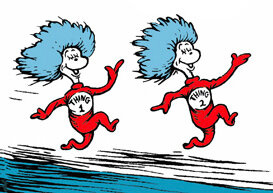
But here’s a problem: the crew cannot distinguish between the two Spocks. So which to kill? Kirk designates one, arbitrarily ‘Spock One’ and the other ‘Spock Two’, a possible, though I can’t prove it, Dr Seuss reference.
Story-complications depend from this hook: Spock 2 insists that Spock 1 is the ‘false Spock’ and that, moreover, he is operating on a pro-Klingon agenda. The reasoning here is the part of the novel that brings-in the Mirror Universe. Blish doesn’t name it as such, but the influence is clear: the replicated Spock is a complete and rather over-literalised mirror-inversion of ‘our’ Spock, not only physically reversed but morally. The transporter beam produced a fully left-to-right inversion of the original Spock, down to the atomic level, a reversal not merely physiological but also psychological (‘his psychology must be completely reversed’ exclaims McCoy) and therefore ethical. Ultimately we can tell which Spock is which by checking which of them is morally good and which wicked. Indeed it is because his his doppelganger is not only physically but morally reversed that, Spock insists, he must be killed, “even if it is I”.
Mirror-Spock has attempted to disguise his reversion: as Bones says: ‘Only someone with the iron control of a Spock could have made it [the fact of the inversion] vanish … as the replicate, and a mirror image, he was left-handed, just as we had guessed, but he was suppressing it, as we had also guessed … the mirror-reverse of Spock One went all the way down to the molecular level of his being. Those nutrients we have to have, he cannot use; and those that he must have, he can’t get from our food.’ It is this that finally gives him away: faux-Spock uses the Enterprise's science facilities to synthesise the chirality-reversed amino acids he needs to survive (‘“He set himself up to synthesize all twentyeight amino acids for himself, and in bulk,” Kirk said. “In a word — whew!” [77]).
When the Enterprise finally arrives at Organia, a strange ‘mental field’ afflicts the crew: ‘“one thing we all noticed about the present condition of Organia,” McCoy said, “is that it has a unique and severe mental effect upon every man and woman on board the Enterprise. It repels us emotionally, as sentient creatures, just as surely and as markedly as it reflects Scotty’s insensate elementary particles” [83].3 Kirk authorises a landing party, which discovers that the Klingons did not destroy the Organians after all, but only imprisoned them using a hitherto unknown weapon that locks them away somehow. Spock-Two, the echt-Spock, deduces what it is: ‘a thought-shield around Organia … the advantages to the Klingons are evident and considerable. Primarily, of course, the screen confines the Organians — who are nothing but thought-fields — to their own planet, and prevents them either from knowing what is going on outside, or acting upon it. And secondarily, it removes the planet from sight and contact from the outside. The field as we experienced it is emotionally repulsive.’
This emotional repulsivness (as an Englishman, it is a concept I know well) ‘prevents the mind from even thinking about Organia except as an extinct planet’—hence the belief that the Klingons had destroyed the place. Spock-Two goes on:
The shield is the Klingons’ one and only new weapon, the discovery of which encouraged them to start the forbidden war. This would explain why we found a Klingon garrison of some size posted nearby; they do not want anyone else investigating the situation or even understanding why it is important to them. As a further derivative, this weapon is apparently not very manageable yet except as a gross effect — that is, on a very large scale — or they would be using it in battle, against our ships, and to great tactical advantage. [85]
This doesn’t seem wholly logical: that this new weapon, which blocks and modifies thought and perception themselves, cannot operate at small and localised but only at large and interplanetary scales, would surely make the Klingons more, not less, likely to use it in war against the Federation. Anyway Spock-Two kills Spock-One, obviating any further inconveniences of having more than one Spock running around:
Was there also a slight suggestion of hatred on the face of Spock One? Kirk could not be sure; the two faces were so alike, and yet, and yet...
“It is well that we should ‘meet again at last’,” Spock Two said. “Your existence and your plotting are an offense against the natural order, as well as a source of displeasure to me. It is high time they were brought to an end.” [102]
The two duel by using ‘telepathic/hypnotic skills’ that results in a surreal sequence of events, dust-storms and tornadoes, until Spock Two drives Spock One into the thought-shield, killing him (‘he was a creation of the screen to begin with, and knew he could not survive a second exposure’ he explains).
Scotty then finds a way of undoing the thought-screen. Released, the Organians take their revenge by throwing a bubble of asymptotically slowing time around the Klingon commander Koloth’s ship as it closes in on the Enterprise. Koloth informs his superior, Admiral Korax, that he is going in for the kill (‘he knew that Admiral Kor also cherished personal desires to rid the universe of Kirk and his ship’) but to no avail:
For what Koloth did not know was that it had taken him a Klingon year simply to call Korax; that the entire galaxy had made its twenty-seventh rotation since its birth around its center during the course of their conversation; and that since then, it had gone around three and a third times more. For the Destruction and all aboard her. Time was slowing down on an asymptotic curve; and for Commander Koloth, the chase would never end. [120]
Presumably from Koloth’s point of view the cosmos around him would appear to speed-up prodigiously, just as from ours he and his ship would appear to slow down. But Blish doesn’t go any further with this concept, and it doesn’t appear in any subsequent Trek. The novel ends with the Enterprise continuing its five-year mission.
Nobody in the novel shows any compunction whatsoever about killing Spock-One, because, the implication is, he is not ‘really’ alive, and is certainly not ‘really’ Spock. His pro-Klingon plotting but also his very existence are, real-Spock declares, ‘an offense against the natural order’. We can read this as the novel implying, though it doesn’t outright say, that Spock-replica does not have a soul. Spock’s ‘katra’, concerning which later Trek would have much to do, did not survive the strange tachyonic transporter journey. And if it didn’t survive that journey, we can ask: does any soul survive any transporter beaming?
Blish’s novel ends with a restating of the question with which it began:
McCoy said: “does the man who comes out of the other end of a journey by transporter have an immortal soul, or does he not?”
There was quite a long silence.
“I do not know,” Spock said at last. “I can only suggest. Doctor, that if someone were to give me an answer to that question, I would not know how to test the answer. By operational standards, therefore, such a question is meaningless.”
“I suppose so,” McCoy said resignedly. “Somehow I thought that was just what you’d say.”
Kirk had rather expected Spock’s response, too. But he noticed also that the first officer looked, somehow, faintly worried. Or did he?
Blish, a trained scientist (he studied microbiology at Rutgers University and worked as a medical laboratory technician before becoming a full-time writer) grew fascinated with theology and the occult towards the end of his career: after A Case of Conscience (1958), in which a Jesuit priest visits a planet whose aliens, he becomes convinced, are untouched by original sin, he wrote a thematically linked trilogy: Doctor Mirabilis (1964) Black Easter (1968) and The Day After Judgment (1971) in all of which ‘magic’ is treated as scientific. In Black Easter Hell is real, black magic works like science, devils can be conjured to operate in the world and souls can be traded, Faust-like, for folding-money. In Spock Must Die Blish hints, as in this final exchange between McCoy and Spock, that souls are real in the Trekverse too. Spock One
As I say, Spock Must Die does not specifically reference the ‘Mirror Mirror’ episode, nor use the Mirror Universe as an explanation for the appearance of Evil Spock (as it could easily have done: the transporter somehow plucked beard-Spock from the Mirror Cosmos and brought him here—although this would run into the problem that the ‘Mirror Mirror’ episode ends with Spock converted to virtue by Kirk). Nevertheless it shares with the Mirror-universe conceit the idea that the universe has a fundamentally moral structure, that a person’s virtuous nature is as much a part of them as their heart beating stronger on the left or being right-handed, such that reversing a person’s symmetry also reverses their ethical identity. As Kalen points out, ‘the existence of the Mirror Universe, considered rigorously, means that the Trek universe has a god’. This is right, and it entails the notion that the people in the Trekverse do have souls. Mirror-Universe folk have wicked souls, and regular universe folk have good souls, but Blish, in this novel, is toying with the idea that the transporter is a machine that strips out soul altogether, leaving users like Peer Gynt in Ibsen’s play: he ends desperately trying to commit a sin grave enough to have him sent to Hell, because unless he does his soul will be melted down. This prospect, having no soul and going nowhere when he dies, terrifies Peer, and he would rather keep his soul and go to Hell that suffer such a fate. Is the Trekverse populated by soulless automata, denatured by their use of transporter technology, trundling along like Peer Gynt to existential nothingness?
It would be interesting to write a Trek novel that follows-through on Blish’s implication. Federation scientists discover that people do indeed possess immortal souls but that passage via transporter strips these souls away, leaving people hollowed-out copies of their former selves, identical except that they lack soul. Discovering such a dire fact would mean that all transporter activity for new babies, and for people who have not yet used the technology, would cease—although not for people who have already been been transported, who would have nothing more to lose, and could continue to use the system. But as they grew older, and died into absolute nullity, neither ascending to Heaven nor consigned to Hell, there would be fewer and fewer. The last generation to use transporters would eventually dwindle away and the technology would be discontinued. A bleak sort of a story premise, but with potential. Though Paramount would never license it.
I sometimes wonder if Christopher Priest was aware of this in-fandom discussion, and drew on it for his novel The Prestige (upon which Christopher Nolan based his celebrated movie). I knew Chris but never asked him this question, and now, alas, cannot.
I once wrote a novel called The R!-Town Murders, a SF whodunit set in a near-future version of Reading, Berkshire, a few miles from where I live. In the novel most people have abandoned the real world for more alluring virtual realities, and in a desperate attempt to coax people backto reality, the town has undertaken a rebranding exercise, calling itself ‘R!-Town’ (‘My town! Your town! R!-town!’). My publisher, Victor Gollancz, vetoed this title. Having an exclamation mark in the middle of a book-title would, I was told, confuse BookScan, so they wouldn’t be able to gather meaningful data on sales etc. I was, you can imagine, disappointed.
In an interesting anticipation of Panpsychism, Blish appends this: ‘“Dinna be sae sure,” Scott said darkly, “that electrons don’t think.”’
For the record, I have Definitively Established that the transporter does not kill and clone you:
https://old.reddit.com/r/DaystromInstitute/comments/2zglxb/why_the_transporter_doesnt_kill_you_at_one_end/
Echo Round His Bones by Thomas M. Disch explored this concept as well.