
The Einstein Compensator
On Stardates, Time Dilation, and Unexpected Consequences

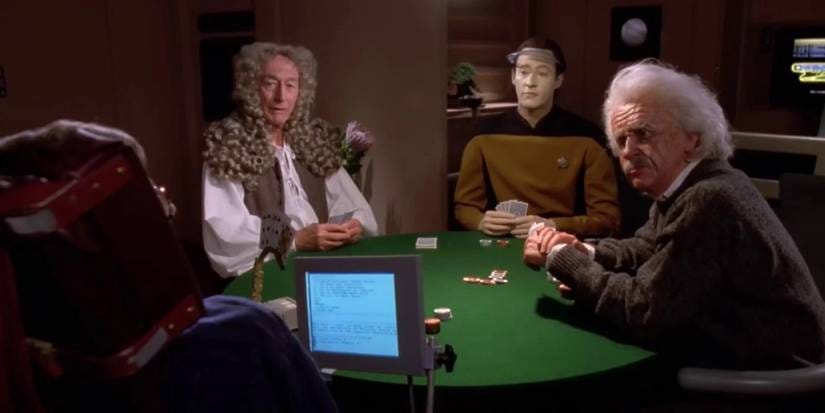
Inspired by the other Adam’s foray into the thorny territory of transwarp, I wanted to explore another can of canonical worms: stardates. These numerical strings are undeniably iconic—most captain’s logs begin with the stardate—but also problematic.
The history behind them is complex, as multiple contradictory motives converged on these seemingly arbitrary strings. On the one hand, the production crew wanted flexibility and ambiguity as to the exact timing of the events portrayed, so as not to tie themselves down to any particular theory of future technological development.
On the other hand, there was some desire to reflect a more “scientific” form of datekeeping than our current Gregorian system, pegged as it is to the supposed year of the birth of Christ and the length of a random planet’s orbit around its star. The purely numerical character of stardates was suggested by the “Julian day,” a method for correlating astronomical events on very long timescales, though the system itself generated unwieldy numbers and cut against the desire for ambiguity (as every “Julian day” corresponds to a conventional calendar date). A more scientifically ambitious rationale for the stardates comes from Samuel A. Peeples, who wrote the script for the second pilot, “Where No Man Has Gone Before”:
They marked off sections on a pictorial depiction of the known universe and extrapolated how much earth time would elapse when traveling between given points, taking into account that the Enterprise’s warp engines would be violating Einstein’s theory that nothing could exceed the speed of light. They concluded that the ‘time continuum’ would therefore vary from place to place, and that earth time may actually be lost in travel. ‘So the stardate on Earth would be one thing, but the stardate on Alpha Centauri would be different,’ Peeples says. ‘We thought this was hilarious, because everyone would say, “How come this date is before that date when this show is after that show?” The answer was because you were in a different sector of the universe.’”
I’m not sure this explanation makes a lot of sense on its own terms. But it is interesting as an attempt to respond to Einstein’s theory of relativity. As is well known, Einstein argued that, for the speed of light to remain constant from all possible reference points, space and time need to function differently at different velocities and under different accelerations. This is true even on earth. If one member of a pair of identical twins moved to the mountains while his brother lived in a valley, the mountain-dwelling twin would have been moving at a faster speed (tracing a slightly larger orbit in the same timeframe) and hence lived infinitessimally longer than his less elevated brother. The effect is particularly dramatic in a hypothetical space vessel traveling at a significant fraction of the speed of light. A crew could come back from a mission that took years from their perspective and arrive home to find that everyone they knew had been dead for generations.
Clearly, taking Einstein’s theory of relativity seriously as a constraint on Star Trek technology would have been incompatible with telling the kinds of stories they wanted to tell. (In fact, it would seriously call into question what it would even mean for events to occur “simultaneously” at all, which is perhaps what the reference to differing time continuums is gesturing toward.) Accordingly, I am aware of no instance of Einstein-style time dilation in any actual canonical Star Trek production. There are exceptions in the tie-in literature, most notably in David Mack’s Destiny trilogy, where Captain Erika Hernandez and the crew of the Columbia NX-02 (briefly seen in Enterprise season 4) lose warp capability and have to fly at high sublight speeds. More recently, in the comic series The Last Starship, they postulate that Borg transwarp conduits are subject to time dilation, which, like most of the series’ ideas, makes no sense whatsoever.
Yet this is supposed to be a science fiction show. Einstein’s theory of relativity is a pretty central plank of our contemporary understanding of the universe. Even acknowledging that faster-than-light travel already contradicts Einstein, there seems to be no reason to assume that the problem would be less if your velocity kept increasing. What is the solution to this thorny issue? For The Original Series, the answer was simply to ignore it. Even the garbled theory about different time continua in different parts of space—which seems to have been intended at least partly as a joke—never explicitly made it on screen. Everything proceeded as though they were travelling according to classical mechanics with no speed limit.
The later franchise basically ratified this approach by positing that the warp field that allows for faster-than-light travel also prevents the effects of time dilation. (As for impulse power, which encompasses high sublight speeds, there is a widespread fan consensus that some kind of warp field is involved as well.) In short, the future fantasy physics of Star Trek basically turns the clock back to Newton, using the warp field as a kind of “Einstein compensator.”
This phrase is of course inspired by the “Heisenberg compensator” that is canonically part of the transporter device. Many fans have suggested that, no matter what the writers intend, the “kill-and-clone” theory is the only way it is conceivable for the transporter to work. Ironically, though, according to our present scientific understanding, even that would be conceptually impossible, because reassembling the body perfectly on the other end would require knowing the position and velocity of every particle—and Heisenberg’s Uncertainty Principle posits that it is impossible to know both things at once about any given particle. Hence the Star Trek writers invented a device that—as with the magic of the warp field—would counteract twentieth century physics and return us to the world of classical mechanics.
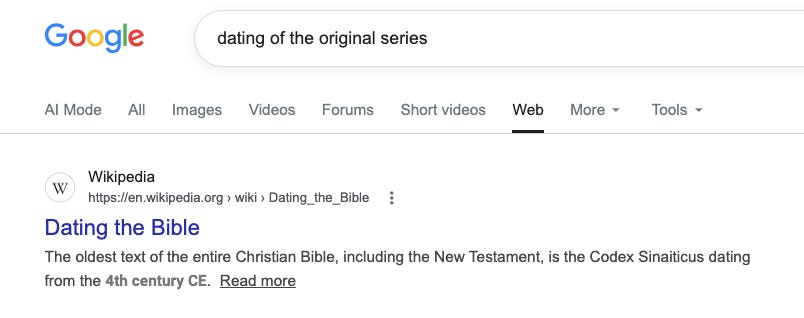
In short, the science of the 22nd century and beyond have reset back to the science of the 19th century. This is, to say the least, very strange. Even stranger is the observation that both of these oddities grow out of very early production decisions that were quickly rendered irrelevant. Stardates were intended to create ambiguity about the timing of events from The Original Series, but the early season 1 episode “Miri” established that it was roughly 300 years into the future, a convention that (with some exceptions and arguable errors) quickly became the fandom’s collective headcanon and was subsequently endorsed by later productions. If anything, the trend has been to make dates ever more concrete and specific—and yet stardates have persisted, even though no system to rationalize them has been fully successful. (Incidentally, below is an amusing screen shot from my research into this important question.)
As for the transporter, it was invented to save them the cost of creating an additional set for a shuttle craft. And yet, lo and behold, in the season 1 episode “The Galileo Seven,” they did indeed spring for a shuttle craft set, which (judging from the looks of it) cannot have been very expensive. But they had already used the transporter many times and even made it the basis of a bizarre thought experiment (the morally “split” Kirk of “The Enemy Within,” which was, unimaginably, only the fifth episode to air!), and so they were stuck with it and all the existential crises and tortured speculation it would engender. It is hard to think about the fact that we ultimately owe Tuvix to a budget constraint that was almost immediately overcome.
Your note that Star Trek has never done a proper relativistic time dilation story in hundreds upon hundreds of hours is really striking, and speaks to the power of the pseudoscientific technical manuals that "explain" how warp drive "actually works."
The closest I can think of is that one planet in Voyager's "Blink of an Eye," which is accomplished through a different sort of handwaving (the magic of tachyons), or (I suppose) the various time-travel stories that have people encountering their ancestors or descendants (which have the tropes of the classic time dilation narrative with a different cause). But by and large the need to retain pre-Einsteinian physics for warp travel has seemingly overriden the need to find new stories they haven't done multiple times yet over 60 years of Trek production!
It would be quite tricky to create space opera science fiction that actually obeys the laws of physics, which clearly dictate that space colonisation is not possible because everything is just too far away.