
Why Doesn't Every Starfleet Wessel Have A Ship's Counselor?
*Vessel

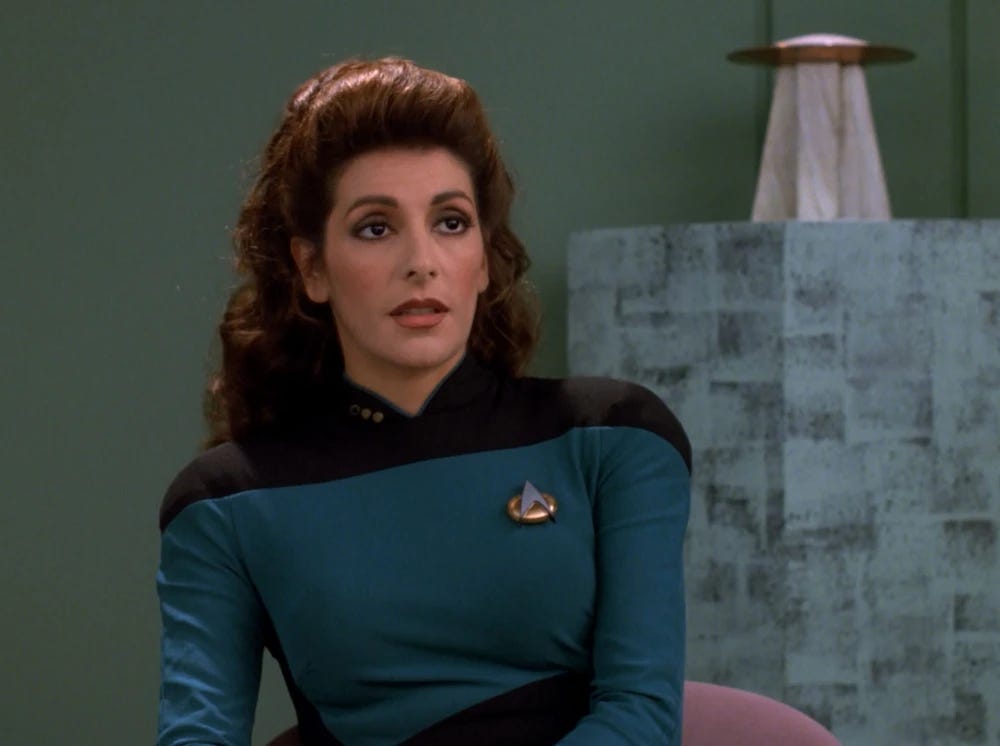
Let’s start from the premise that mental health and wellbeing are absolutely as important as physical health and wellbeing, and that an enlightened future-society, such as the Federation, would recognise that fact. A starship would need its crew to be in good physical, but also in good mental, health. Star Trek: the Next Generation recognised this fact in the crew-configuration of the USS Enterprise-D, when Deanna Troi (notable Spurs fan, Marina Sirtis) was ‘Ship’s Counselor’, senior bridge-crew (on occasion even finding herself commanding the ship) and a major character. This, we could say, marks the advance of the more enlightened 1980s over the 1960s of Trek’s original crew configuration. Any mental, emotional or psychological problems experienced by the crew of the original Enterprise would, one supposes, be addressed by McCoy scowling unsympathetically and recommending ‘pull yourself together’ or perhaps a stiff Andorian Brandy.

It’s true that Troi-focused storylines were often lame, that there was a tendency to put her in a pastel-coloured room asking this or that character to ‘tell me about your feelings’ in a way that invited fan-mockery and parody, and that her role as counselor—perhaps a situation in itself not especially dramatic—tended to be overwritten by stories foregrounding her love-life, or her Betazoid telepathic-empathetic abilities. Still, she was there, a senior officer on the Federation’s flagship, with as much, as perhaps more, screentime as the security officer and the chief engineer.
But after? The Federation crew assigned to Deep Space Nine were given an inherently stressful and dangerous posting, especially once the Dominion wars kicked off. Sisko had to deal with all the regular stresses of command, traumatic bereavement, single parenthood and also the very different pressures of being a literal alien messiah. Crew suffered all manner of trauma, forcable separation from family and loved ones, peril and shock. Yet the only ‘counselling’ available seems to be, for the crew, alcohol-therapy at Quark’s and, for the captain, holographic baseball.1 [Edit: several comments point to Ezri’s role as counselor of DS9—but not until the final season, leaving the crew mental-healthcare-deprived for six long, traumatic seasons]
USS Voyager was not assigned a counselor at all (according to the anonymous authors of Memory Alpha this was because ‘the nature of its mission didn't require one’, to which we are surely entitled to reply: you what?). The USS Discovery, as perhaps befits a prequel show, reverts to the idea that any mental, psychological or non-physical health issues would be dealt with by the ship’s medical doctor—Hugh Culber (Wilson Cruz), admittedly a more-sympathetic, as certainly a better looking, prospect than McCoy. But Star Fleet Academy, set in the 32nd century, is in effect a High School in Space, and actual High Schools, on Earth, have long recognised the necessity of employing school counselors. Yet the Academy has no Deanna Troi equivalent—although the Academy’s chancellor Nahla Ake (Holly Hunter) takes an, I would say, disproportionate and meddling interest in her pupils’ mental health, and the eighth episode ‘The Life of the Stars’ (broadcast February 26, 2026) was all about enabling the cadets to process their psychological pain by staging a performance of the Thornton Wilder play Our Town. Would such a process really be the best way to counsel young people who have endured trauma, bereavement, stress and dislocation?
We could say that the prominence of Deanna Troi in TNG was ‘of its era’, and that later Treks abandoned it as dated. But I don’t think this is true. If anything we are more aware nowadays of the importance of mental health, and its complex interactions with physical health. Whatever happened to the ship’s counselor role?
One thing I’ve never been sure about: does Quark’s serve actual alcohol, or only synthanol? And why did Sisko never drink there?
It was contentious in its era, too: much of the Sybok plot in THE FINAL FRONTIER (including Kirk's famous "I need my pain!") represents an obvious internal backlash to Troi's presence on the bridge in TNG.
I always assumed that the position of “ship’s councilor” was a kinder, gentler Starfleet version of the old Soviet “political officer” kept aboard to ensure the ship’s loyalty to the Motherland. No wonder Troi sat at Picard’s left hand while Number One Riker was at his right.