
‘Darmok’ Revisited
Jacobs and Roberts at Emirates Stadium

My friend Alan Jacobs, a relatively late arrival to ST:TNG, has been watching the series in order. Recently he blogged his thoughts on ‘Darmok’—one of the most celebrated of all Trek episodes of course—and more specifically his reaction to philosopher Ian Bogost’s long essay on the language conceit around which it is built. Alan both agrees and disagrees with Bogost’s position:
First: Bogost is absolutely right that the descriptions of the Tamarians’ language by the show’s characters — Picard calls what they do “metaphor” and Troi calls it “image” — are wrong.
But Bogost himself is wrong when he says that the Tamarians’ language is “abstract”: abstraction is precisely what the Tamarians are incapable of. They speak almost exclusively in proper nouns, and nothing in language is more concrete and non-abstract than a proper noun. (They also use prepositions and a couple of adjectives and in one case a verb.) They seem to have no word for “sorrow”; they say that people’s faces were wet. They do not speak of “friendship” but rather of “Darmok and Jalad on the ocean.” They don’t say that someone suddenly understood but instead: “Sokath! His eyes uncovered!” Particularity is all they have. Bogost says, “Shaka, when the walls fell is a likeness of failure for the Children of Tama,” but that is to force our abstractions (“failure”) upon a people who recognize no abstractions. Shaka, when the walls fell is is a unique event which nonetheless rewards our contemplation.
Bogost suggests the language in the episode is allegorical, in which communication-signifieds are replaced by others instead of just referring to them. He also argues that the proces of communication on Tamara is a kind of constructive iteration. ‘If we pretend that Shaka, when the walls fell is a signifier, then its signified is not the fictional mythological character Shaka, nor the myth that contains whatever calamity caused the walls to fall, but the logic by which the situation itself came about. Tamarian language isn’t really language at all, but machinery.’ Bogost thinks these instances of communication invite the interlocutor to work through the circumstantial and specific requisites that the more general tenor of the original communication convey. This means that although Tamarian might seem to lack the ability to specify in the way that a technically-advanced space-faring race would surely require—(one of Bogost’s example, rather quaintly for the 24th century, is: ‘how would one say hand me the ¾-inch socket wrench in Tamarian?’)—yet we can imagine the language ‘working’ by starting a process of interpretation in the hearer. One or other of the meme-like statements out of which the language is composed would put the hearer in the position of thinking: ‘I see, I understand the broader circumstance being communicated, so what would be needful to address it? I suppose a ¾-inch socket wrench would do the trick.’ and so on.
Alan is not convinced that ‘allegory’ is the right way of thinking about this language, although he agrees that it can be considered a ‘strategy’ rather than a fixed tabulation of mythemes and their meanings.
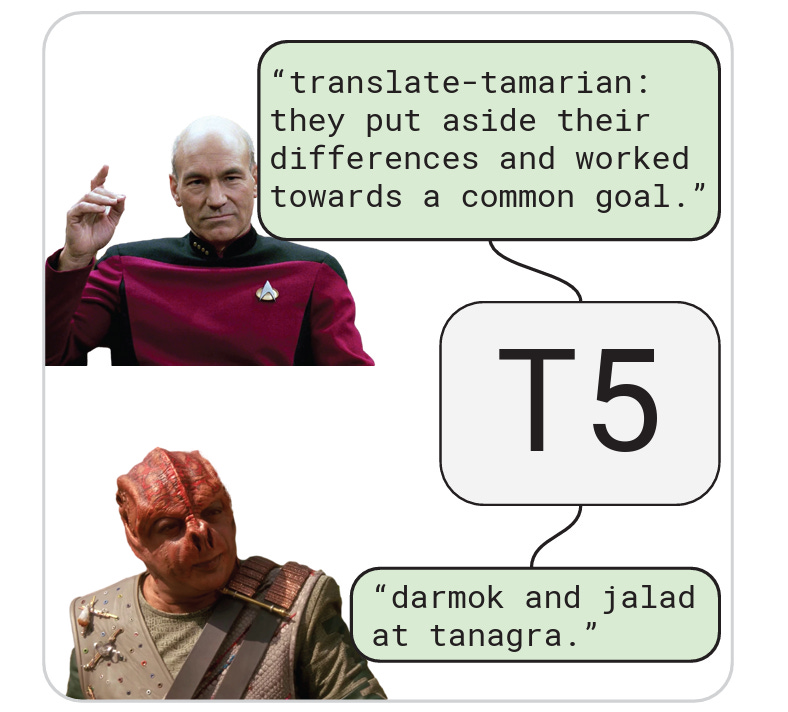
In their essay ‘Picard understanding Darmok: A Dataset and Model for Metaphor-Rich Translation in a Constructed Language’, Peter A. Jansen and Jordan Boyde Graber collate all the canonical instances of Tamarian (from this episode of the show, and from spin-off Trek novelisations) into a database of 48 terms, by way of assembling a preliminary mechanical English-Tamarian translator. The image at the head of this post is a diagram of this translation-programme in action, from their paper. They also include this table:
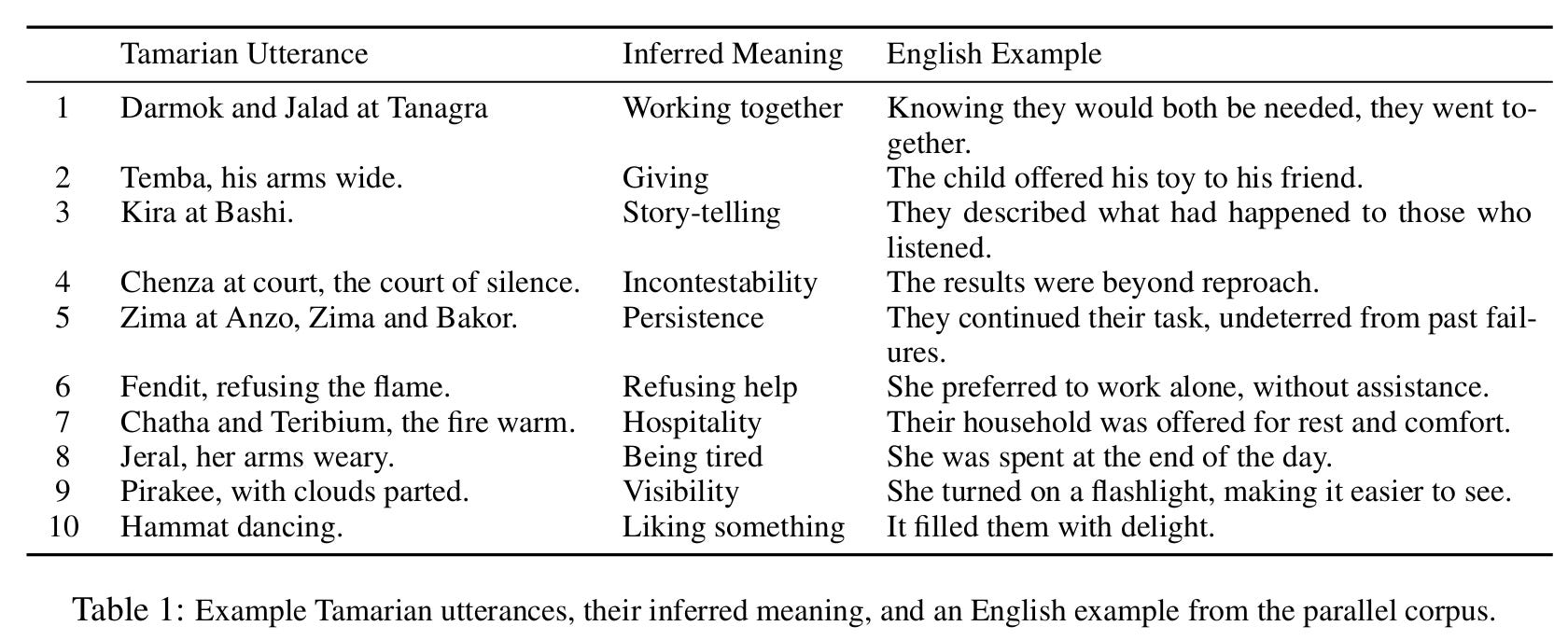
This whole paper is very interesting, although the approach requires Jansen and Graber to find Tamarian ‘equivalents’ for the semantic units of English statements or requests that are likely to be fed into the algorithm. An example they give is: ‘hand me the blue screwdriver on the left’ being broken down into: Temba, his arms wide [‘giving, inviting generosity’], Paris, in the garage [‘screwdriver’], Tolanis painting, in winter [‘blue’], Bakor, examining [‘look to your left’]. I wonder, though, if this is the best way of apprehending what is going on with this language.
The ‘Darmok’ episode strikes me as very effective drama. The scriptwriter’s thumb is a little in the balance by the need to disable the Enterprise’s transporter with a magic ‘field’ (for otherwise Riker would pluck Picard away immediately and there would be no story)—although the scene where Picard is stopped at the very moment when Dathon needs his help by the Enterprise attempting (and failing) a transporter rescue is very well done. But the main force of this episode depends on our familiarity with the ‘universal translator’ conceit, such that we are engaged by the mystery as to why it doesn’t work in this instance, or why it only partly works (for some of Dathon’s words are comprehensible, and others are proper names). The explanation for this, and the revelation of the nature of the Tamarian language, is nicely paced, for all that the narrative peril is somewhat forced. We viewers come slowly to understand that this is not a language that operates in the way most galactic languages work, but by inference, by appeal to shared cultural prior knowledge. That Picard is able to intuit that cultural prior knowledge for several instances of Dathon’s speech, seems plausible to me, for we often deduce or interpret through context and assumption. Then again, I’m not sure I see how Dathon himself—since the implication of the show is that Tamarians use only these meme-figurations to communicate—is able to follow Picard’s account of the Epic of Gilgamesh at the end. But still. The episode works because, once the idea has been woven in, we grasp it with reference to our own experience. We can imagine ourselves saying ‘Romeo serenading Juliet on her balcony’, or ‘Frodo and Sam at the cracks of Doom’, and thereby communicating vibes to whomever. By the end the viewer has been introduced to a neat linguistic spin on the idea of alienness as such, to the notion that not everything is reducible to a human-familiar default.
Bogost’s essay is quite famous, and Alan’s engagement with it smart. But I’m going to disagree with both, and to suggest that a different linguistic logic could be at work where Tamarian is concerned.
In Samuel Delany’s Babel-17 (1969)—I have no idea if the ‘Darmok’ scriptwriters were aware of this novel, though it is one of Delany’s best—humans are fighting an interstellar war against an alien species that seems linguistically denuded, although they not only communicate amongst themselves readily but operate sophisticated interstellar spaceships. The humans come to realise that, rather than being a simplified or pared-down language, aliens speak a tongue that is immensely specific and adapted to their circumstances. Rydra, a human linguist who has been studying various alien languages spoken in this galactic future, explains to another character (she’s talking about a different alien species to the ones humanity is fighting):
Take the Ciribians, who have enough knowledge to sail their spaceships from star to star: they have no word for “house”. “home” or “dwelling” … their whole culture is based on heat and changes in temperature. We’re just lucky they do know what a family is, because they’re the only ones beside humans who have them. … There is a huge solar-energy conversion plant that supplies all the electrical energy for the [human] Court. The heat amplifying and reducing components take up an area a little bigger than Jebel. One Ciribian can slither through that plant, and then go describe it to another Ciribian who never saw it before, so that the second can build an exact duplicate, even to the color the walls are painted—and this actually happened, because they thought we’d done something ingenious with one of the circuits and wanted to try it themselves—where each piece is located, how big it is, in short completely describe the whole business, in nine words. Nine very small words, too.’1
In the paper linked above, Jansen and Graber assemble a lexicon of 48 Tamarian locutions, because that’s all the Trek canon provides. Obviously the Tamarians must have more than 48 signifiers. But what if they have a great many more—what if there are, say, 100,000 of them? There are roughly that number of distinct characters in written Chinese. Could it be that Tamarian speech is more like Chinese sinograms than it is like memes? Sinograms are sometimes simple ideogrammatic representations, and sometimes (like Tamarian) composed of separate elements combined. I am no expert, and do not speak Chinese, but the example offered as canonical online is 明 (’bright’), the combination of the sinograms for the two brightest objects in the sky: 日 (‘Sun’) and 月 (‘Moon’).
We could take Tamarian to be a spoken-language equivalent to this written logic. And if the Tamarians had access to 100,000—or, who knows, more?—communicative units, they could have a wide range of very specific and precise expression: one locution for hand me the blue screwdriver on the left, and another for hand me the ¾-inch socket wrench, and another for my hovercraft is full of eels and so on. From what we are shown in the show, each idiolectic expression combines an individual and a place, or a couple of individuals. They would have idiolectic phrases for anything they might need, including abstractions.
Of course, we don’t see 500,000 individual Tamarian locutions in ‘Darmok’: a 45-minute TV drama can only include a few instances of expression. More, we can assume that the examples we do encounter in the episode are instance of Dathon trying to teach Picard how to speak his language from first principles. One does not start such a process with complex abstractions or technical specificities. One would open with a simpler set of words: not pidgin-Tamarian exactly, but a kind of linguistic primer. This is to disagree with Alan’s description of the Tamarians as ‘a people who recognize no abstractions.’ I’d imagine they have a range of expressions for abstractions too. But then Alan and I do sometimes disagree. We don’t support the same football team, for instance.
Samuel Delany Babel-17 (1969), 132
I've always been a "Darmok" Truther. It is not an entertaining episode and it is especially not a very rewatchable episode -- it is frustratingly slow, because our characters need to be made artificially stupid not to catch on to the conceit much quicker. That's because "Darmok" is an *idea*, not a story, and the only way to fill the time of a story with an idea is to spin your wheels. And rather than the various theories showing that the episode is exceptionally rich, I prefer to interpret this situation as indicating that the Tamarian language is an incoherent concept that doesn't actually make sense.
To me, the richest reading of the episode is as a sly critique of Star Trek fans (and young men generally) who talk to each other in a code made up of pop culture references.
Thanks for this, Adam. As Smerdyakov says, It’s always worthwhile talking with a clever man.
1) I am new specifically to this series, but not, as I mentioned in an email to you, to Trek: https://blog.ayjay.org/excerpt-from-my-sent-folder-trek/
2) It’s of course true that if there were a people like the Tamarians, they would have to employ abstract thought, or they couldn’t have developed the technologies they use. But to make this point, is, I think, to refuse the thought-experiment of the episode, which is: What if they *didn’t* have any abstractions, could only cite historical examples? Could Picard adapt to that?
3) I don’t think Dathon really follows Picard’s spirited retelling of Gilgamesh and Enkidu, in the sense that he couldn’t re-tell the story himself. But he intuits what *kind* of thing Picard is doing, and in his last moments this comforts him. (A moving scene, for me.) It would be as though you were dying in a strange land and the people there began playing music for you, music whose structure and idiom you don’t understand, but which you know to be music. You would feel the appropriateness of it even if you don’t grasp it and feel it as the strangers do.
4) Your reference to BABEL-17 is a good one. I had actually thought of extending my post by a riff on Miéville’s EMBASSYTOWN. A Trek/Delany/Miéville linguistic triangulation would be fascinating.
5) Maybe we could extend these thoughts even further by invoking Ernest Fenollosa's THE CHINESE WRITTEN CHARACTER AS A MEDIUM FOR POETRY, which is wrong, but for the purposes of this discussion interestingly wrong.
6) Alan supports no football club. Alan needs no football club.