
Ex Astris, Scientia
Some pedantry

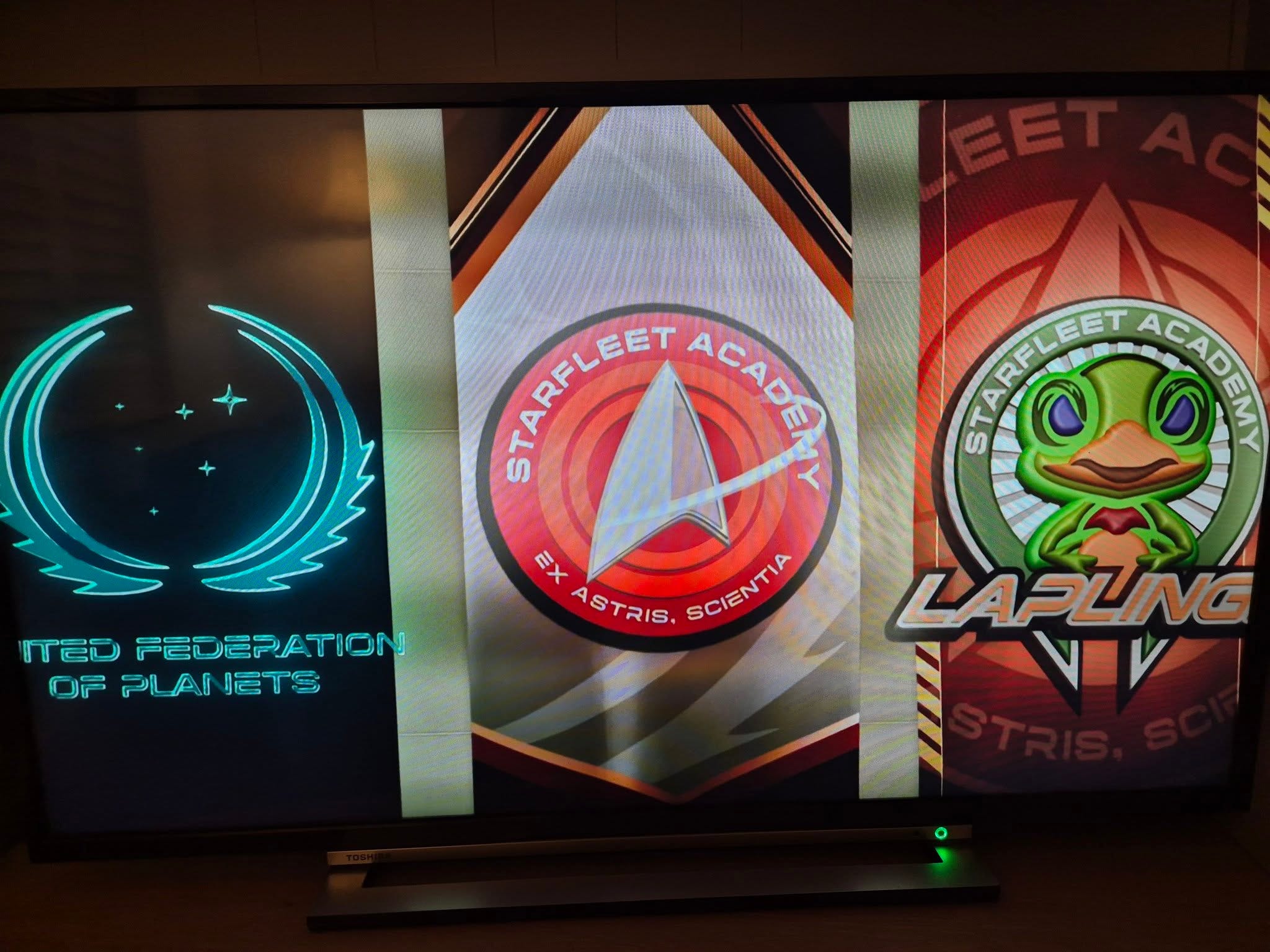
Watching Star Trek: Starfleet Academy I have been reminded (if I ever knew it) of the Academy’s motto: ex astris, scientia. This means ‘science, from the stars’, or ‘out of the stars—science!’ It is grammatically correct, in its Latin, although that’s not going to stop me sniping at it. Oh no!
So: astris is the ablative plural of astrum, ‘star’. The noun is in the ablative because ex (out of, moving away from) requires that to which it attaches take the ‘ablative of place’. The final word scientia is in the nominative singular, because it’s the subject of the phrase—we could translate the whole as ‘science [comes] from/out of the stars’. Although translating scientia as ‘science’ is a little tendentious. It’s a word with a complex of significations in Latin: meaning (as an abstract): ‘knowledge, awareness, cognizance’ as well as ‘learning, learnedness, erudition’; and (in a concrete sense): ‘that which is known’, contradistinct from a mere belief or assumption, the Latin equivalent of the Ancient Greek ἐπιστήμη (epistēmē). In Medieval Latin the word comes to mean ‘science’ as an organized branch of methodically-acquired knowledge with a unified subject-matter, which is what science means nowadays. But we could if we wanted to translate the phrase as ‘out of the stars [comes] knowledge’.
It’s a phrase with a particular (actual) history, modelled by Star Trek scriptwriters on ex luna, scientia, the official motto of the Apollo 13 lunar mission. This phrase means ‘out of the moon [comes] knowledge’, although in the event the main knowledge gleaned from this voyage was the ways in which spacecraft can malfunction and how to bodge together repairs in space. But still.
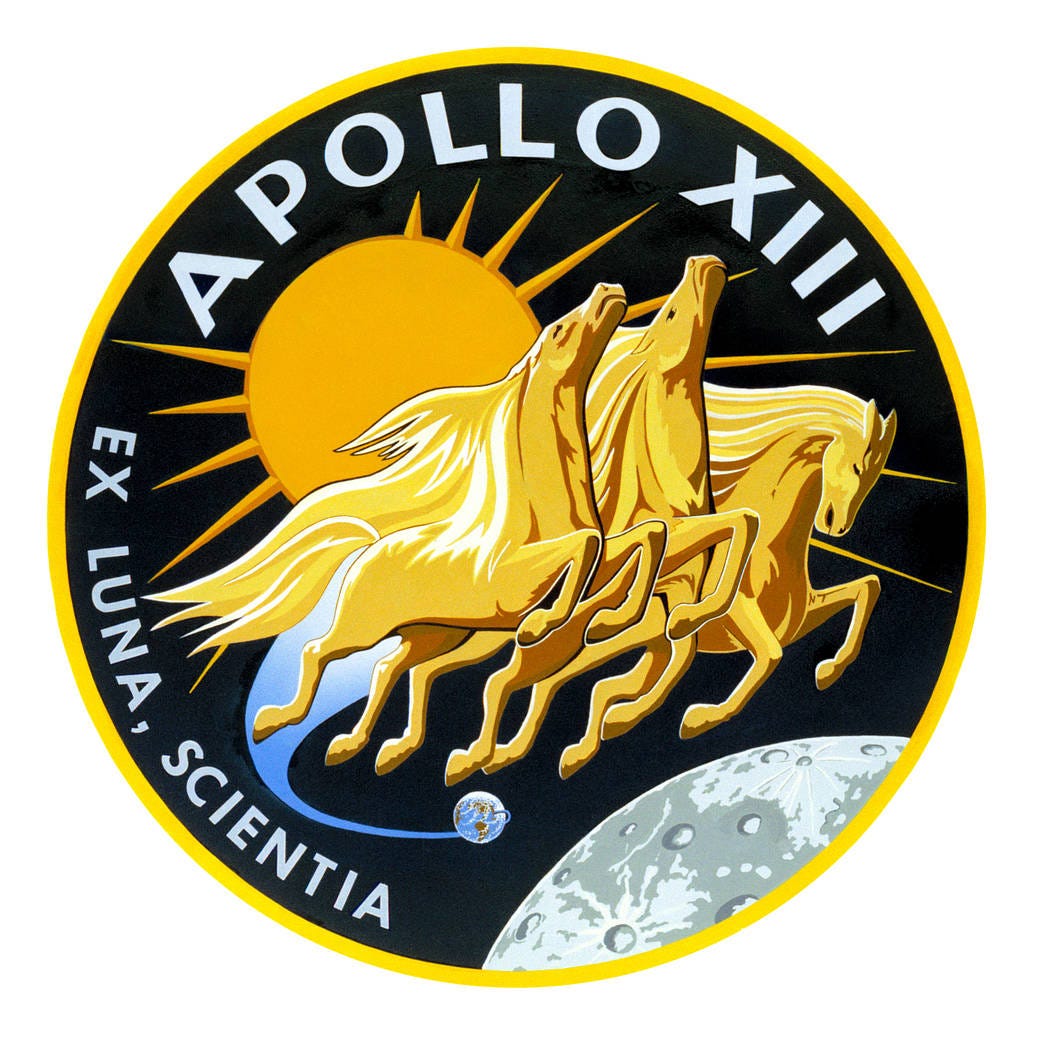
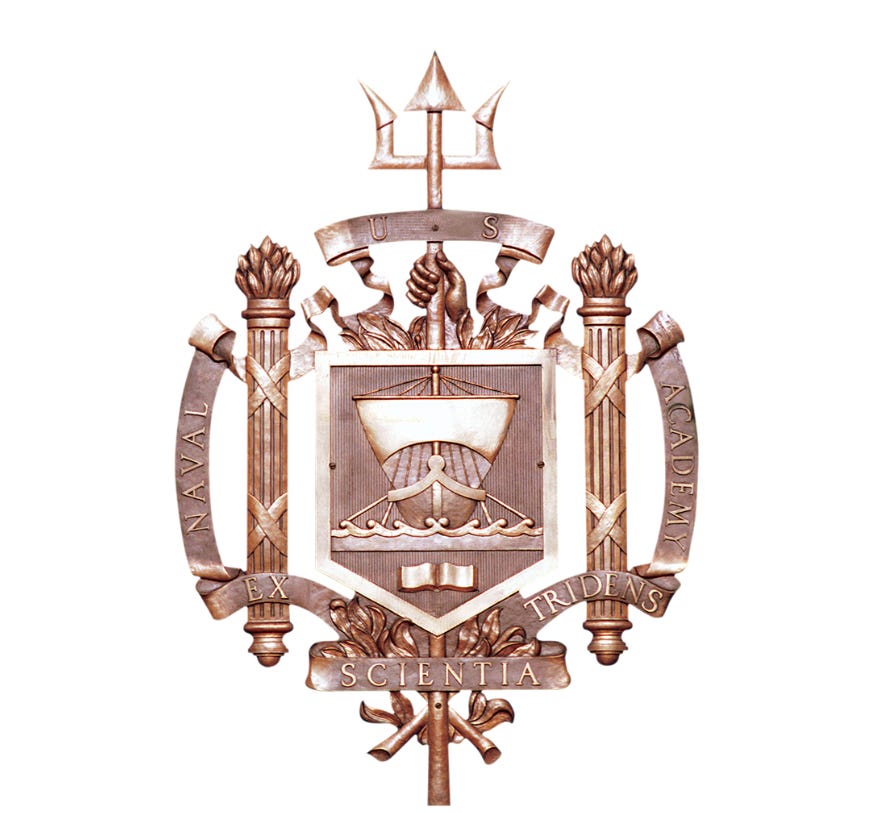
This motto was chosen by Jim Lovell, Apollo 13’s commander, who based it on the motto of the US Naval Academy (which he had attended as a cadet): ex scientia tridens, ‘out of science/knowledge [comes] the trident’—which is to say: ‘out of knowledge [comes] sea-power’, because the trident was wielded by the powerful sea-god Neptune.
Both of these, the Apollo 13 and the USNA phrases, manifestly owe something to e pluribus unum, the official motto of the United States of America, as featured on its Great Seal. This takes the same shape: e (the Latin is ex if the word that follows begins with a vowel, but can be e if a consonant) ‘out of’, pluribus, ablative plural of plus, which in its plural form means ‘more, several, many’, and unum, the neuter nominative singular ‘one’. The recent show Pluribus of course makes reference to this, and Other-Adam had written on this very ’stack about that show’s relationship to Trek.
That’s the immediate heritage of the motto. My snipy pedantry? Well, since you ask …
Given the low level of Latin literacy in Hollywood, I ought not cavil—I think, for instance, of the fact that the recent movie Kingdom of the Planet of the Apes (2024) could not, in its $160 million budget, find the money to pay someone with sufficient knowledge to correct the scriptwriters’ decision to call the villain ‘Proximus Caesar’. Ex Astris scientia isn’t wrong in the way that name is wrong.1 But cavil I shall.
One thing is the comma after astris, which no Roman would add in this instance. Two is the word astris. It is, as I note, the correct ablative plural of astrum, ‘star’. But astrum is not the regular Latin word for star—that’s aster (whence we get our English word ‘asterisk’). Astrum is, rather, the poeticised, fancy-pants word for it, the kind of word a highfalutin poet might use. Again, this isn’t wrong as such, although it’s odd in the Star Trek context. It speaks more to astrology than astronomy: a 1618 volume has the title Acroteleuticon Astrologium, sive divinationem ex astris: ‘The Ends of Astrology, or divination out of the stars’. To couple this with scientia looks odd. The phrase would more logically be ex asteribus scientia.
But then again, Starfleet is not merely extracting knowledge from stars, but from everything out there: stars, planets, nebulae, strange alien craft and so on. The more natural Latin for this would be caelum, which means the sky in its extended sense—all the heavens, the milky way, the whole spread of stars and alien worlds, the root of our modern word ‘celestial’. This gives us e caelis scientia, which I think has a lovely sound to it.
None of this has any actual bearing of Star Trek, really. It is, as I say, pedantry, and the notion that this has come within a million parsecs of impinging on the consciousnesses of any Trek scriptwriter is zero. There’s some fandom grumbling about the fact that the gleaming technofuture of the Federation is interested in something as musty-fusty as Latin at all. But it’s not as if Starfleet Academy makes much, or emphasises at all, its Latinity.
I suppose we could say: the reason Starfleet Academy has a Latin motto (incongruously, since we’re more than a thousand years in the future) is that Latin has a status the vernacular lacks. From being a lingua franca, Latin became an elite language spoken only by the highly educated (and following that, only by an even smaller group of obsessives, language-nerds and trad Catholics).2 If a school (and Starfleet Academy is a school) posts a Latin motto, it is a claim to status, an elitist signifier. For a far future academy in which most students are not even human, and so don’t share the cultural heritage in which Latin was important, makes this marker, shall we say, problematic. But the specifically American valence of this particular Latin motto—the doomed Apollo 13 mission, the military academy of which Starfleet Academy is an echo, the Great Seal of the United States of America itself—link us not back to the Roman, but rather to the American, empire.
Kingdom of the Planet of the Apes (2024) is the fourth instalment of the Planet of the Apes reboot franchise and ‘Proximus Caesar’ is the movie’s big villain, the tyrannical king of the Coastal Ape Colony, a rogue clan of apes that claim to follow the ways and teachings of the late Caesar—the Moses-figure, who in the first trilogy led the apes to their promised land, played by Andy Serkis in a mo-cap suit. The later movie is set many generations after Caesar's death, and Proximus is claiming to inherit Caesar's mantle. Hence his name, which the movie clearly thinks means ‘the next Caesar’, ‘Caesar's successor, next-in-line’. It doesn't, though. Proximus means next in a purely spatial sense: nearest-to, alongside, adjoining. But the name, or title, invented for this character isn't supposed to mean that this new Caesar occupies a physical propinquity to the long-dead original Caesar. It is clearly intended to point to a temporal succession: ‘heir to Caesar’ ‘Caesar's rightful successor’. What the film wanted was Successor Caesar, or perhaps Hereditarius Caesar. But the scriptwriter presumably typed ‘next Caesar’ into Google Translate or equivalent and copied-down proximus from the list of options. This is indicative of a larger problem with online resources like Google Translate, of course. ‘Proximus’ is not a wrong translation of ‘next’ into Latin in an absolute sense—it’s just wrong in this context.
Kenneth Haynes traces the way Latin went from, in the sixteenth and seventeenth-centuries, being preferred to national vernaculars because ‘it increased the potential audience for scholarly works’ (Newton wrote in Latin) to being used in the nineteenth- and twentieth-centuries for exactly the opposite reason: to exclude unlearned, vulgar and ‘unfit’ readers. [Haynes, English Literature and Ancient Languages (Oxford 2003), 7-10]
One extra piece of pedantry: over on Facebook, Murray Leeder points out that the first time we see Starfleet Academy, in the TNG episode "The First Duty," the motto is "Ex Astra, Scientia," which is ungrammatical. It was later, in the "Homefront/Paradise Lost" two parter, that they corrected it.
As a lapsed linguistician and a Trekkie, I've spent many happy hours headcanoning the universal translator. In one of my fanfic pieces, a character who happens to be a bit of a language nerd herself gives a detailed explanation of (my idea of) the UT. (When I posted this on the STO forums, I followed it immediately with a grovelling apology to the furious ghost of Ludwig Wittgenstein.)
Yer basic UT, as seen in TOS "Metamorphosis", is explicitly a mechanical telepath. It receives an input (not necessarily an audio input, since it's reading the Companion's energy emissions in that story) and latches on to the concept behind it in the mind of the speaker; then it converts the input into something the listener understands. The exact method for doing this is (ahem) left as an exercise for the alert student.
Since the 23rd century hand- held device is about the size of a tube of Pringles, we can figure that the technology is fairly compact. So we can also figure that it's incorporated into comms equipment - subspace radio and the like - so it can be used at long distances. But it's also based on the immediate intentionality of the speaker - it only picks up the utterance that the speaker is actually intending to communicate. So things like deliberate quotes in a foreign language, or comments muttered under one's breath, won't be translated. And written language, where the original utterer isn't anywhere near the utterance, can't be translated on that basis.
Yer full-scale UT package, then (IMO) consists of the mechanical telepath and a gigantic database of languages, written, spoken, or otherwise uttered. It can translate written language, if it can find sufficient matches in its database. But without the telepathic component, it can't produce output in the seamless fashion of the conversational UT. You may hear Standard English instead of tlingan Hol, but you won't see written English instead of Klingon script.
Such, at least, is my opinion.