
Inner Lights and Rascals
Parsley, Sage, Rosemary and Time

This is a follow-up, in a manner of speaking, to other-Adam’s recent post exploring the ways in which Trek does time travel—a pendant to that post, looking at two examples of stories that are not strictly time-travel, but are time-travel-adjacent.
What do I mean by ‘time-travel-adjacent’? The protocols (as it were) for SF time-travel are pretty well established, generically speaking. The first ‘machine that enables time travel’ story is H G Wells’s The Time Machine (1895) although there are ‘time travel’-ish stories that predate that—Dickens’s Christmas Carol (1845) for example, sends its protagonist into the past, into the future, and even, remarkably, tacitly endorses the branching-timelines idea (because, as the book’s final paragraph makes plain, after Scrooge returns to the present and changes his ways, Tiny Tim does not die). But in that story ‘time travel’ happens via magic and ghosts, not via ‘technology’. It is not predicated upon any scientific or pseudo-scientific premise.
Once Wells had established the template for a pseudo-scientific mode of time travel—time as ‘the fourth dimension’ along which it is possible to move just as we do in the other three—a welter of Pulp SF time travel stories followed, with its now-familiar variants: travel into the future or the past via a machine, or portal, or hot-tub; encountering one’s family or oneself and interfering with the development of one’s timeline (for example, the grandfather paradox); travelling into the past and altering the present even without intending to (as with Ray Bradbury’s ‘A Sound of Thunder’ (1952), when a time-travelling big-game hunter goes back to shoot dinosaurs—the company organizing such trips impresses upon him not to deviate from the path and only to kill the dinosaurs marked as set to die anyway, but he strays from the path, inadvertently crushes a butterfly and so alters his own timeline irretrievably). This last conceit soon coalesced into a shared sense that ‘time’ was a branching sheaf of possibilities, such that a traveler backwards might easily nudge ‘the timeline’ from its historical path into some new tributary: the ‘multiverse’.
It may be relevant to a sense of Trek as a franchise that TOS (which of course several times traded in ‘time travel’ narratives) was originally broadcast alongside two popular SF TV shows that were fundamentally about time travel: in the UK Doctor Who (BBC: 1963-present) and in the US The Time Tunnel (ABC, 1966-1967). In both cases, one of the prime notions was that the shows could act as both entertaining drama and as educational history, by putting on screen important historical characters and circumstances (Trek has sometimes also done this) although in the case of Dr Who storyworld soon left pedagogy behind to leap between its various imagined futures. Trek several times returned to the 19th-century American West (The Time Tunnel similarly: lots of trips to the American Civil War) and to the American 20th-century: a futuristic pan-stellar civilization might not, we could posit, be so fascinated by this particular window in US history, were the shows we’re talking about not made by American creators. But alright.
And actually what I want to get at in this post is less nationalist-historical, and more individual-psychological. To that end I’m interested in two Next Generation episode in particular—not,as I say, strictly ‘time travel’, but in substantive ways adjacent to that conceit.
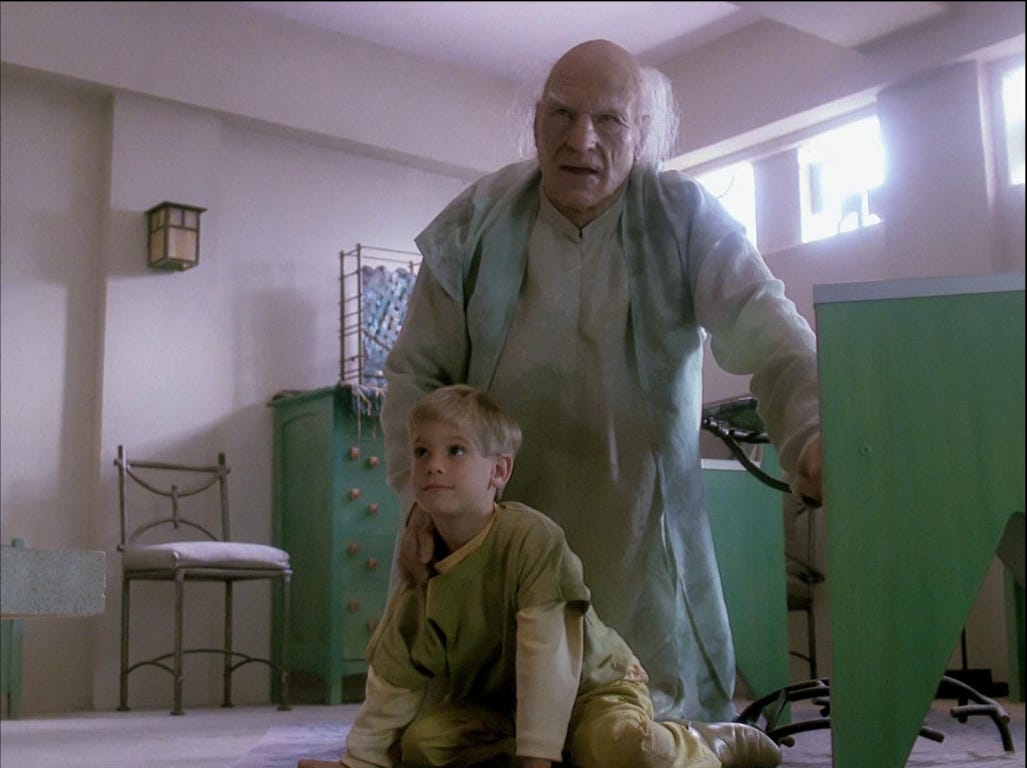
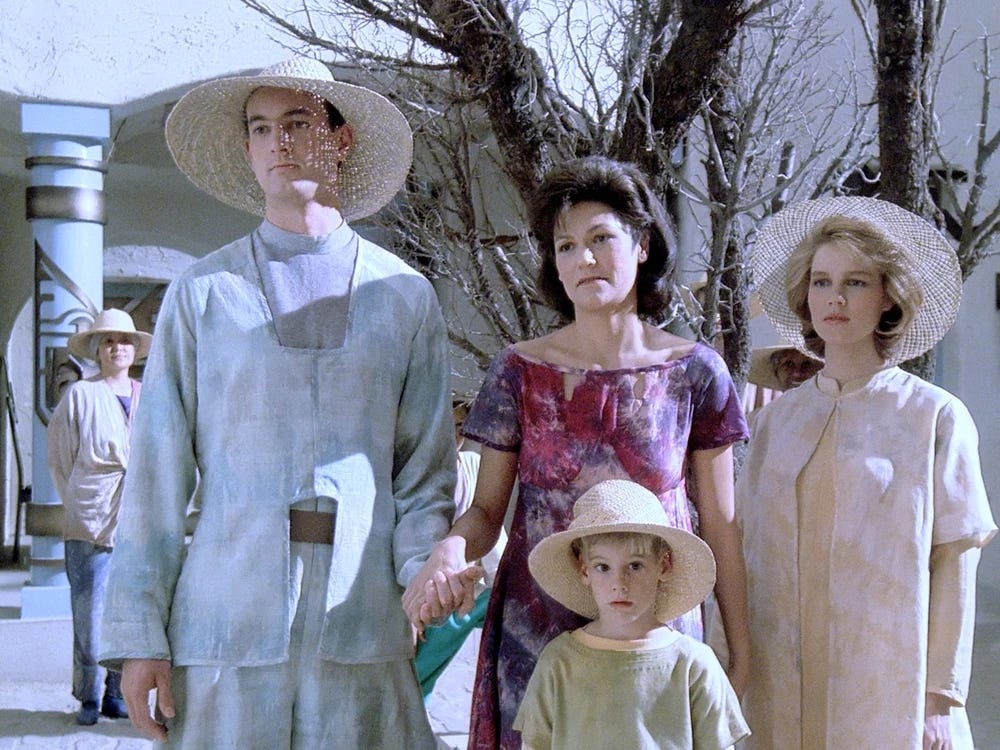
The first is the Next Generation episode “The Inner Light” (S5, ep 25), a sealed-off story (which is to say, not one with any substantive implications for Trek as it continued on, not a story that spawned any alternate timeline that resonates through later TNG episodes). The Enterprise encounters an alien probe in deep space. As they scan it, Picard is suddenly ‘taken’ from the bridge, relocated to an alien planet, and in that place lives the rest of his life, marrying and having a family, growing old, and ending the episode on the verge of death. In fact he never leaves the Enterprise: the alien probe is compelling him to experience an absolutely immersive hallucination, or mental experience, or perhaps an actual reality (it’s never quite made clear) in which many perceptual decades pass for a few hours in our (that is, the Star Trek prime) universe. Picard grows old enough to have not just children but grandchildren, exists wholly in this alien society for more than half a century, and only as he approaches death does the probe release him, back into the actual world, so he can ‘tell the story’ of this (we discover) long-vanished civilization.
In other words, Picard lives his whole life, but this existence is a stub, a diversion from his ‘actual’ timeline, and at the end of the experience he reverts to the start again, to live his ‘actual’ life.
I do love this episode, although it seems to me to bury its lede. What fascinates me about it most is the abruptness of Picard’s rearrival in his ‘actual’ life. It brings to mind the Narnia stories. In C S Lewis’s The Lion, the Witch and the Wardrobe the Pevensie kids pass from WW2 England, through the titular magic wardrobe, into the land of Narnia, arriving in a wood beside an incongruous metal lamppost. In Narnia they have various adventures, defeat the White Witch, and grow to adulthood as the kings and queens of Narnia, until, decades later, they chance upon the lamppost again and tumble back into our world, no longer adults, now children, only a few hours having passed on Earth for all the many Narnian years. That Lewis stops his story there has always struck me, frankly, as a mistake:—for surely this is where things get really interesting. What would it be like to have an adult consciousness inside the body of a child? To have passed through puberty, and then suddenly to revert to infncy, to have the hormone tap switched off? You could hardly go back to your former existence; but neither could you expect to live as an adult. How would you cope? The psychological interest in the story begins at the end; but that’s exactly the place where Lewis stops. Similarly with Picard: he lives his whole life and then, as if by magic, is whisked back from end-of-life decrepitude to being in his prime, and he gets to live his whole life again. He is instantaneously bereaved of his wife, children, grandchildren and whole world. This is where the story gets interesting—how Picard copes with such a state: although all that the episode gives us by way of wrap-up is a brief coda where Picard sits down with Deanna Troi to undertake a bit of therapy, and also Picard tootling on his alien flute. This instrument is his one takeaway, which he learned to play during his lifetime away, and which recurs in various later TNG episodes.
There’s an added wrinkle to the time-travel-adjacency of this story, in that Picard’s son in this episode is played by Picard’s actual son, actor Daniel Stewart.
There’s something key to time travel in this, I think. To have children, and watch them grow up, is in a sense (in a literal genetic sense, in a metaphoric subjective sense) to revisit one’s own youth, to go back in time, to inhabit your parents’ roles and so to become them. In an old post on Harry Potter, I considered the ‘time-turner’ that comes into Hermione’s possession in Prisoner of Azkaban, which she uses repeatedly jump back in time some hours, so as to attend twice as many classes as her fellow schoolchildren, because she’s such a swot:
In Prisoner of Azkaban, why is Hermione so tired all the time? We’re told it’s because, using the time-turner, she’s doing twice as much school work. But she has a time-turner! Why doesn’t she use it to do twice as much school work and get twice as much sleep? But this is to nit-pick. Hermione’s time-turner has its manifest role in the plot, but it has a much more resonant and powerful latent role in the thematic through-line of Prisoner of Azkaban as a novel; which is why it appears in that novel only, and isn’t needed for later instalments. That’s because Prisoner of Azkaban brings one of the main themes of the series as a whole into a particular dramatic focus. I’m talking about the relationship between the parental generation and the children who succeed them. Harry misses and idolises his parents. As the novels go on he discovers his Dad was a bit of a bully when he was Harry’s age. In Azkaban, threatened by Dementors, Harry is saved by somebody casting a patronus spell: a stag. He thinks this is his father, except obviously it can’t be, since his father is dead. At the end of the novel it turns out that it was he himself, time-returned, who saved himself. Wendy Doniger is right about how forceful and touching this scene is: “Thanks to a wonderfully complex and subtle episode of time travel that traces a Möbius twist in the chronological sequence, Harry encounters himself in the loop where past and present come together and overlap. The first time he lives through this period, he sees, across a lake, someone he vaguely recognises: perhaps his father? No, his father is dead, but that person sends a silver stag which saves him from present danger. When he goes back in time, he runs to the same place to see who it was, and there’s no one else there: he is the one who sends the stag to save himself in the future. The moment when Harry realises that he mistook himself for his father is powerful; and it is, after all, the only real kind of time travel there is: each of us becomes, in adulthood, someone who lived some thirty years before us, someone who must save our own life.”
I suppose I’m suggesting that the tenor of ‘time travel’ as a narrative conceit is as much as a metaphor for psychological, familial reengagement as it is for ‘fourth dimensional’ thought experimental appurtenances. That it is, in other words, a proxy for memory (how much more vivid than mere mental remembrance is literally travelling back to your youth, or your parents’ youths, as in Back to the Future) and also for anticipation, a way of dramatising aging and death. In A Christmas Carol Scrooge gets to revisit his happy youth and reconsider the life-choices he made that left him rich but miserable—and he gets to go into the future and discover the thing that lies in all our futures: death. Scrooge’s stubborn blindness in the face of what is obvious to us as readers (that the horrible old miser who has died, that everyone is talking about, is him, that the gravestone has his name on it) speaks to our resistance to the uncomfortable prospects of mortality. Surely I won’t die! But I will.
In Wells’s Time Machine, the time traveler zips, first, to the year 802,701 and discovers that humanity has evolved, or devolved, into brainless pretty childlike Eloi and canny, monstrous, cannibalistic, subterranean Morlocks. But then he travels further ‘forward’ in time, he encounters a sequence of later devolutions: humanity becomes a species of giant crab; then, as the sun swells red in its dying throes, filling the sky, we devolve into something more monstrous: strange globular creature, like giant eyeballs (‘I fancied I saw some black object flopping about upon this bank, but it became motionless as I looked at it’) upon a terminal beach. The end.
It is, I think, not coincidental that the first thing Wells’s time traveler encounters in his future is a Sphinx. The Oedipal reference is pointed. Oedipus, in the myth, solves two riddles. First he meets the Sphinx, and solves her riddle: ‘What is that which in the morning goes upon four feet; upon two feet in the afternoon; and in the evening upon three?’ It’s a very famous story, and a very famous riddle, although that very fame should give us pause. Oedipus’s answer is ‘man’, who crawls on all fours in his infancy, strides on two legs in his maturity, and walks with a stick in his dotage. It is the trajectory as much as the actual answer here that is relevant to Wells’s sphinxine novella: the passage from our collective infancy, through maturity, and into the decay of the species: Eloi and Morlocks, rabbits and crabs, into something even less definite and so to terminal nothingness.
This riddle is also posed by Wells’s The Time Machine in a more straightforward manner: in the original myth the sphinx describes what sounds like a strange monster (so many shifting legs!) only to reveal the answer that this monster is not so strange; that, in fact, the monster is us. Wells, in effect, does the same, asking of the Eloi: what are these vacuous, diminutive infantile beings, unable to care for themselves? And what are these other monsters, the Morlocks? These pale troglodytes that feed on human flesh? What are these gigantic crabs? This blob of darkness? Once again the solution to the riddle is: they are man. Which is to say: they are you, they are us. It is in this answer that inheres the buried force of the original oedipal riddle, the enduring power of that myth. The sphinx says: ‘I shall describe to you a bizarre-sounding monster. Can you say what it is?’ And Oedipus replies: ‘Le monstre, c’est moi.’
But there’s a second riddle in the Oedipus story, and it is posed not by a sphinx but by the land itself. The fields sicken, the crops die, a curse is on Thebes. This is the situation in ‘The Inner Light’: the good, attentive, hard-working people on the planet to which Picard has been sent get on with their life, try to till the soil and enable the new generations, but their land is cursed. The sun is bleaching their world, and it is dying.
In the Greek mythg Oedipus sets out to solve this riddle too, unaware that it has the same answer as the first one. What is the source of the curse? Oedipus himself. This second riddle both reveals and embodies the short-circuit of existence: man comes from sex, from the mother, into selfhood and along that temporal trajectory sketched by the first riddle towards death, and the mirroring of these two riddles reveals a profound and upsetting truth that all these things are the same thing. Sex is incest, birth is death, existence is a curse, all is folded into all. This, I think, in turn speaks to the story-logic of this Oedipal riddle. We all walk on the two legs of conventional one-second-per-second time travel, but Wells’s ingenious device gives is a third option: to leap over time altogether. He would return to this bizarre world-leaping figure, the tripod, in The War of the Worlds a few years later. We could put it this way: conventional time is a single road, but Wells’s machine gives us a new-branching path, a short-cut, and turns the road into a tripartite crossroad; and if that recalls us to the site of Oedipus’s fatal encounter with the man he did not recognise as his own father, then maybe it is supposed to.1 It’s the sense of returning to the fatal, triadic primal-scene that is powerful; of time rolling back to reveal what nobody saw until now but which has always been true.
This is the stroke of intuitive genius that Wells’s imparted to his story: he invents a machine that offers a kind of ultimate freedom, escape from the ‘now’, the whole of the past and the future our playground. It is, when you boil it down, the fantasy of escaping mortality as such—for what is death but the formal structure of our various individual timelines? Wells’s skill was to realise that the escape-route from death leads directly back to death: the death of the individual becomes the death of the species. There’s a reason Wells’s terminal beach has proved so iconic for science fiction writers.
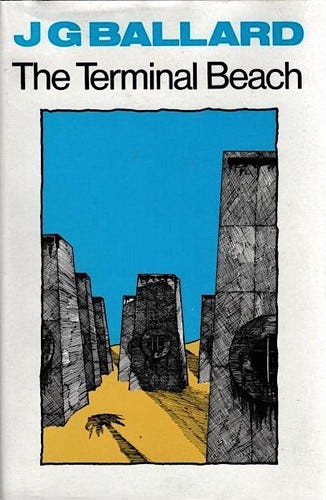
The ultimate destination of humankind’s evolutionary journey through time, according to The Time Machine, is a strange globular creature, at first mistaken for inanimation, as black as blindness, round like one of Oedipus’s plucked-out eyeballs, subsisting at the very end of time that is death.
This seems to me the force of ‘The Inner Light’: Picard living all those decades, growing old and decrepit—as the world in which he lives starts to die, of drought and planetary disaster—until at the moment of death the conjurer’s reveal: he gets to go back in time to his younger self and live his life again! He gets to evade death, and carry his individual mortality and the ending of his world on in memory only. He gets to live a completely different life: not marrying, not having kids (I’m ignoring the absurdities perpetrated by the final series of Picard in saying so), dedicating himself to his job. Like Scrooge, he is shown his own death and then whisked back, temporally, from it, to live again.
Come at this from the other side. In the episode ‘Rascals’ (TNG S6 ep7) a ‘transporter malfunction’—one of the laziest, handwaveiest shifts in Trek, this—turns Picard, Ensign Ro, Guinan and Keiko into their childhood selves (it also somehow shrinks their uniforms to fit their childish bodies).
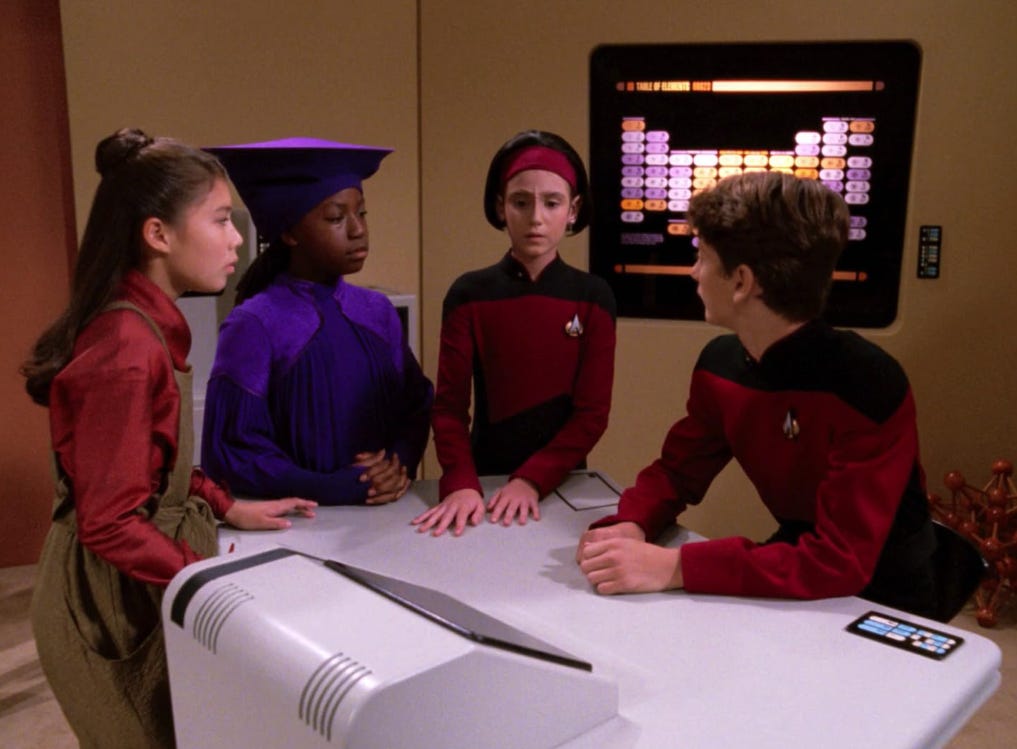
The four manage to defeat a Ferengi take-over of the Enterprise: which is to say, they retain their adult consciousnesses and capabilities. The episode construes some humour out of the incongruity—a callow kid acting with full Picardian pomposity in ordering Riker around—as well as pitching some uncomfortable moments that the scriptwriters presumably thought would be funny: prepubescent Keiko asking Miles if he could still ‘be her husband’ even though she’s stuck in a child’s body. The episode ends, after child-Picard has outwitted the Ferengi and retaken his ship. Of all the episode’s boggling improbabilities (how did the transporter accident not only anti-entropically revert the four crewpeople to childhood bodies, but shrink down their uniforms to fit their smaller bodies? Did the transporter somehow miniaturise Picard’s artificial heart so that it would fit in a smaller body, or did it remove the artificial heart and restore Picard with the actual heart he’d had as a boy? If this latter, then the Federation has found a way of healing all injuries, by ‘transporting’ people back into their bodies just before the injury happened. Or is boy-Picard walking around with an adult-size artificial heart inside him, crushing his lungs and ribs? How are such memories as are stored in adult brains retained when those brains are reverted to a younger state? Or is the idea that the transporter malfunction affects their bodies but not their brains such that, again, these four children, with their child-sized skulls, are walking round with adult-sized brains squashed inside?)—of all these improbabilities, the most boggling comes at the end, where Beverley Crusher works out how to use the transporter to return the four children to their ‘proper’ adult selves. If transporters can be calibrated to adjust the biological age of our bodies, backwards and forwards, then surely the Federation have cured death.2
The nonsensical premise of this episodes points to the foolishness of taking it too seriously. It is a lighthearted, throwaway story. It’s not really saying anything. Compare ‘Disaster’ (S5. ep5), where Picard is leading a group of children on a tour of the Enterprise when the ship hits a quantum-string and is disabled: Picard breaks his ankle, and, to calm the children and motivate them he assigns them honorary command roles, and the group navigates the dangerous territory of the broken ship. This is saying soemthing about growing-up, taking responsibility, about adult-child relationships. ‘Rascals’ has nothing to say about any of this. The time-travel-adjacent conceit is merely squandered.
.
Aeschylus wrote an Oedipus trilogy before Sophocles (Laius, Oedipus and Seven Against Thebes, of which only the last play survives; it ended with a satyr-play called Sphinx). From Aeschylus’s Oedipus only this one fragmentary line survives, spoken by Oedipus himself: ‘We were coming on our journey to the place from which three highways part in the branching roads, where we crossed the junction of the triple roads at Potniae’ [this is Herbert Weir Smyth translation].
Perhaps this mysterious, never-repeated (but potentially life altering) ‘transporter malfunction’ was itself a kind of time travel—it might be tempting to rationalize it that way, rather than have to posit some age-reversing, immortality-creating capacity inherent in transporter technology. Such time-travel would have to be calibrated for each individual: all four become children of roughly the same age, even though their adult ages are very disparate (Guinan is many centuries old, Picard 50something, Ro and Kieko in their 20s and so on). What is clear, in a larger sense, is that Trek doesn’t fully explore the potentials opened up by the ‘actuality’ of time-travel. It is we could say a flaw in the conception of Dr Who, a being who possesses an actual time machine, is nonetheless tangled in exciting, cliff-hangery adventure and peril. For why would he? In any situation, he could simply get in the TARDIS and go back to a point before he was put in danger, and alter things to keep himself safe. But then again, we might conclude—as a psychoanalyst surely would—that the Doctor is libidinally invested in, precisely, being in temporally-contingent peril. This is, we could say, his kink.
I'm glad you brought up "The Inner Light," because I was trying to integrate it into my post but couldn't quite make the connection. Also relevant here is DS9 "Hard Time," in which O'Brien is made to experience a virtual life sentence in which he winds up killing his only friend for a scrap of food and has to live with the guilt, even though only moments have passed from the perspective of his friends.
As far as the Oedipal element, that is made very, very literal in Back to the Future, which you allude to. I've also theorized in the past that the shift from the Temporal Cold War of ENT s1-3 to the leitmotiv of genetic engineering in ENT s4 is not really a shift at all -- altering your genes is a way of retroactively choosing your parents and thus rewriting the timeline.
So we only discovered stars are powered by nuclear fusion and eventually die in the 1920s and 30s but Wells posited a dying sun, even one that expands and becomes more red when it dies in the 1890s
Are we sure he didn’t actually have a Time Machine and just wrote the book about his travels!! 🙂